
Choughs on the BBC, hang on, I recognise them…
A couple of days ago Fran Miller sent me a link pointing out that some Cornish choughs had made it onto the BBC.
http://www.bbc.co.uk/news/uk-england-15357028
The link describes how four young choughs from West Penwith in Cornwall have made the journey North, up the Cornish coast, towards Newquay and Padtsow. If you’ve kept up with previous entries you’ll know that this group contains two of the boys from the brood that I was watching in the spring. And, even better, the picture shown on the BBC page is of Brownblue and Whitebrown, their proud parents, and the birds that I was blogging about at the time.
For some unfathomable reason, the BBC haven’t used one of my photos.
Another day out with Ron
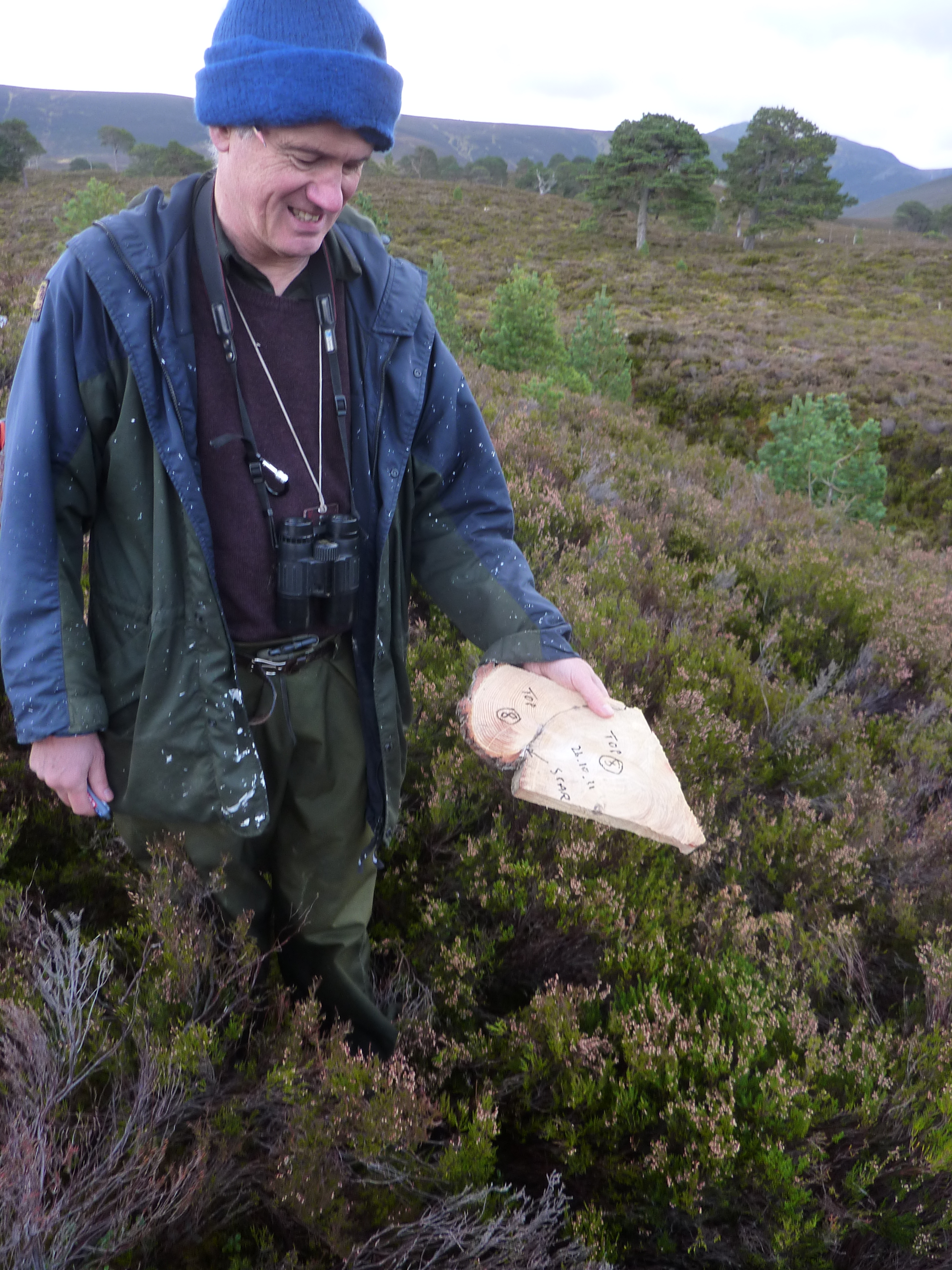
I’ve been lucky enough to spend another day with Ron Summers again today. This time Rachel and her friend CJ, both from St Andrews university, joined us. Rachel is studying how trees on the reserve can provide a map of when and where fires took place at Abernethy for her final year degree paper. Today they had a glorious chance to watch me cut wedges forth from Scots pines with a carefully wielded chainsaw.
-
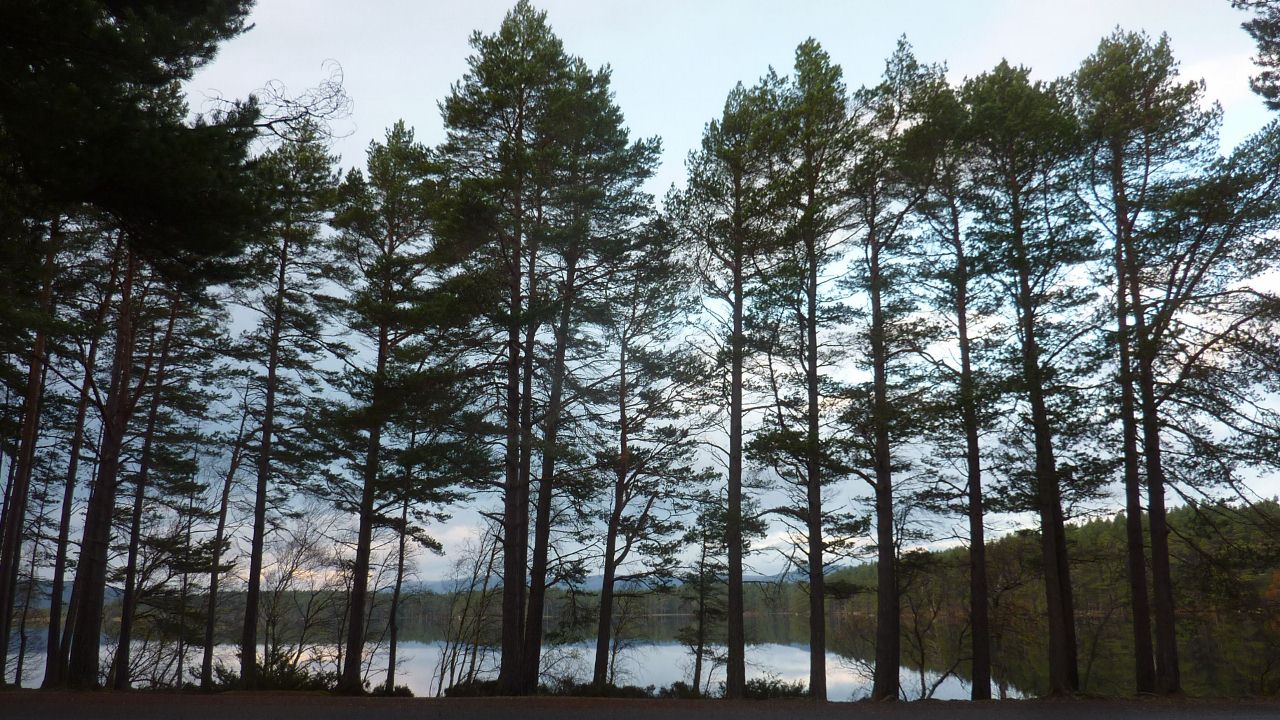
- Loch Garton
-
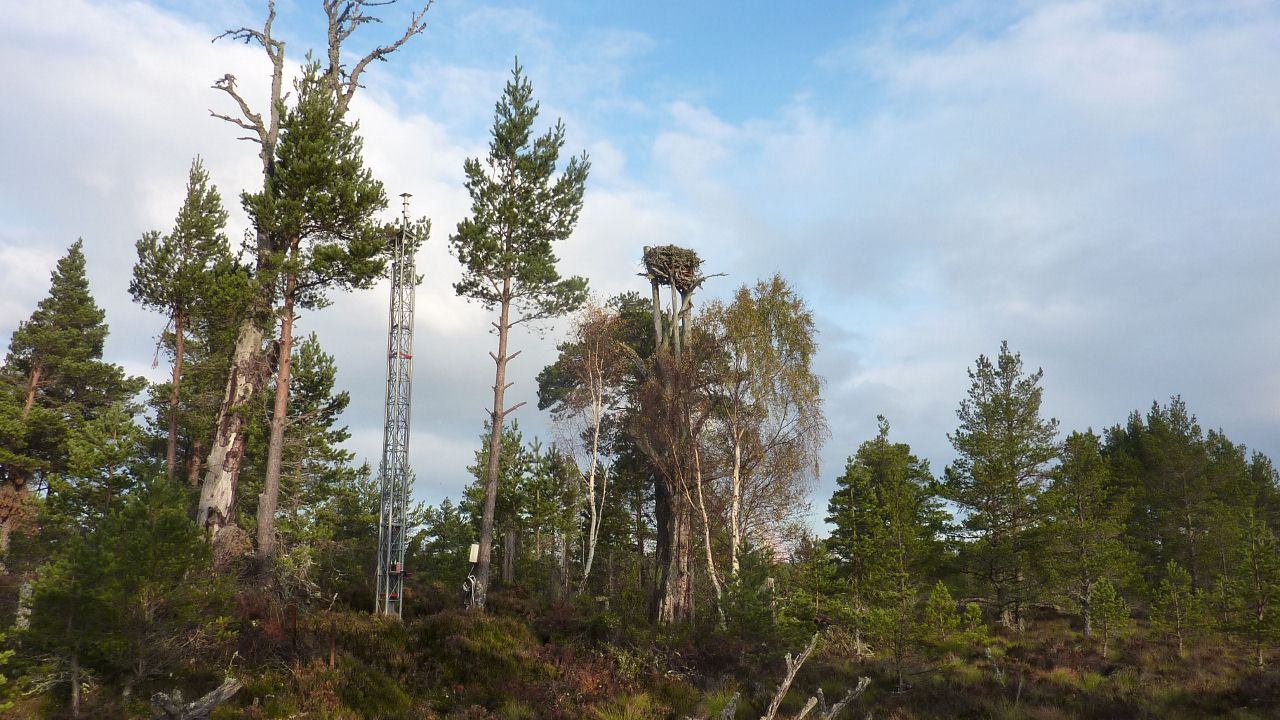
- Who would live in a house like this?
-

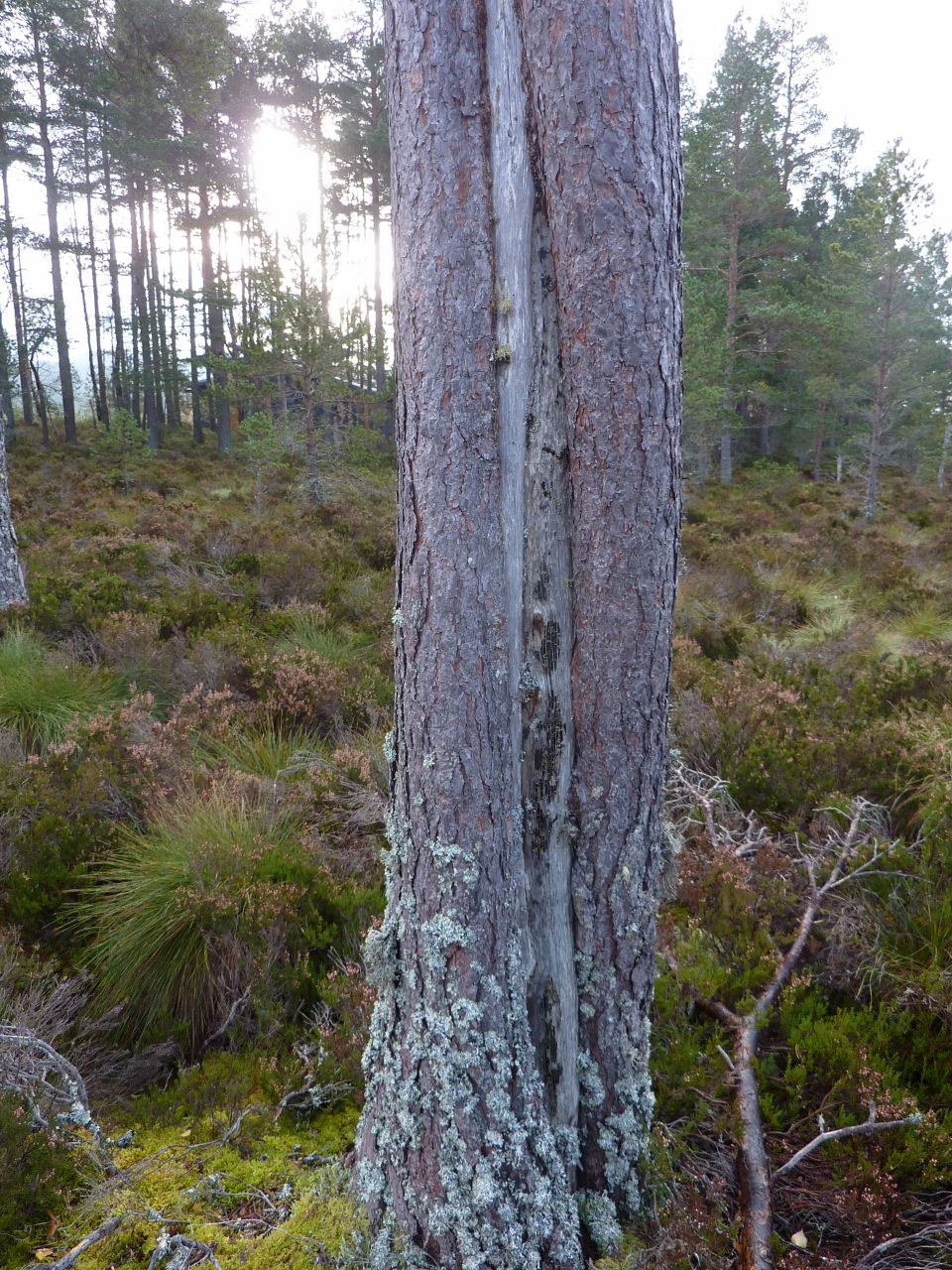
- Not one, but two firescars (you can see where the first is charred)
-
- Ron and a wedge.
-
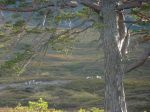
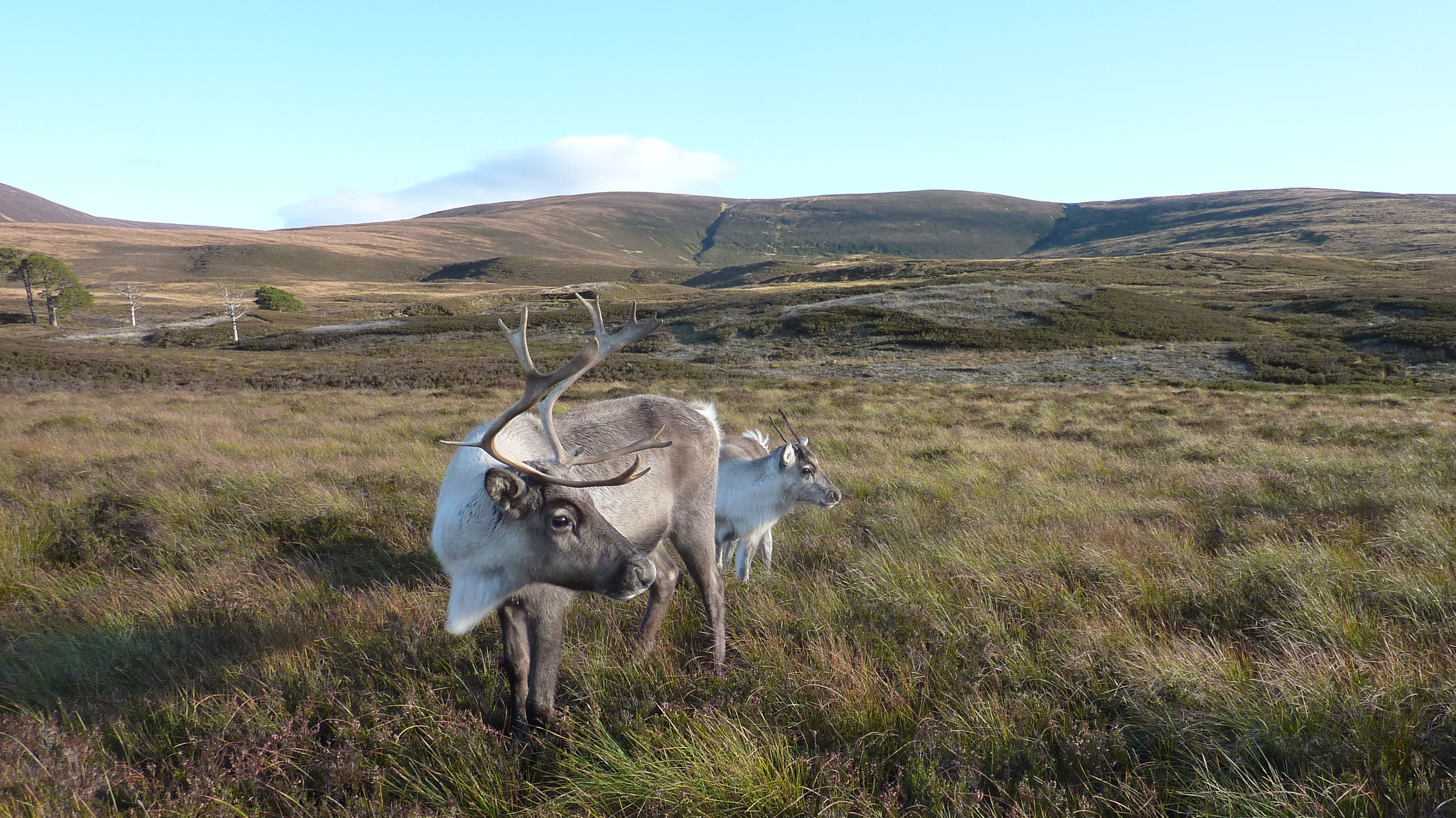
- Reindeer sometimes wander onto the reserve from the local reindeer farm

-
- They are fantastically cute, but not welcome visitors, as they eat the regeneration
-
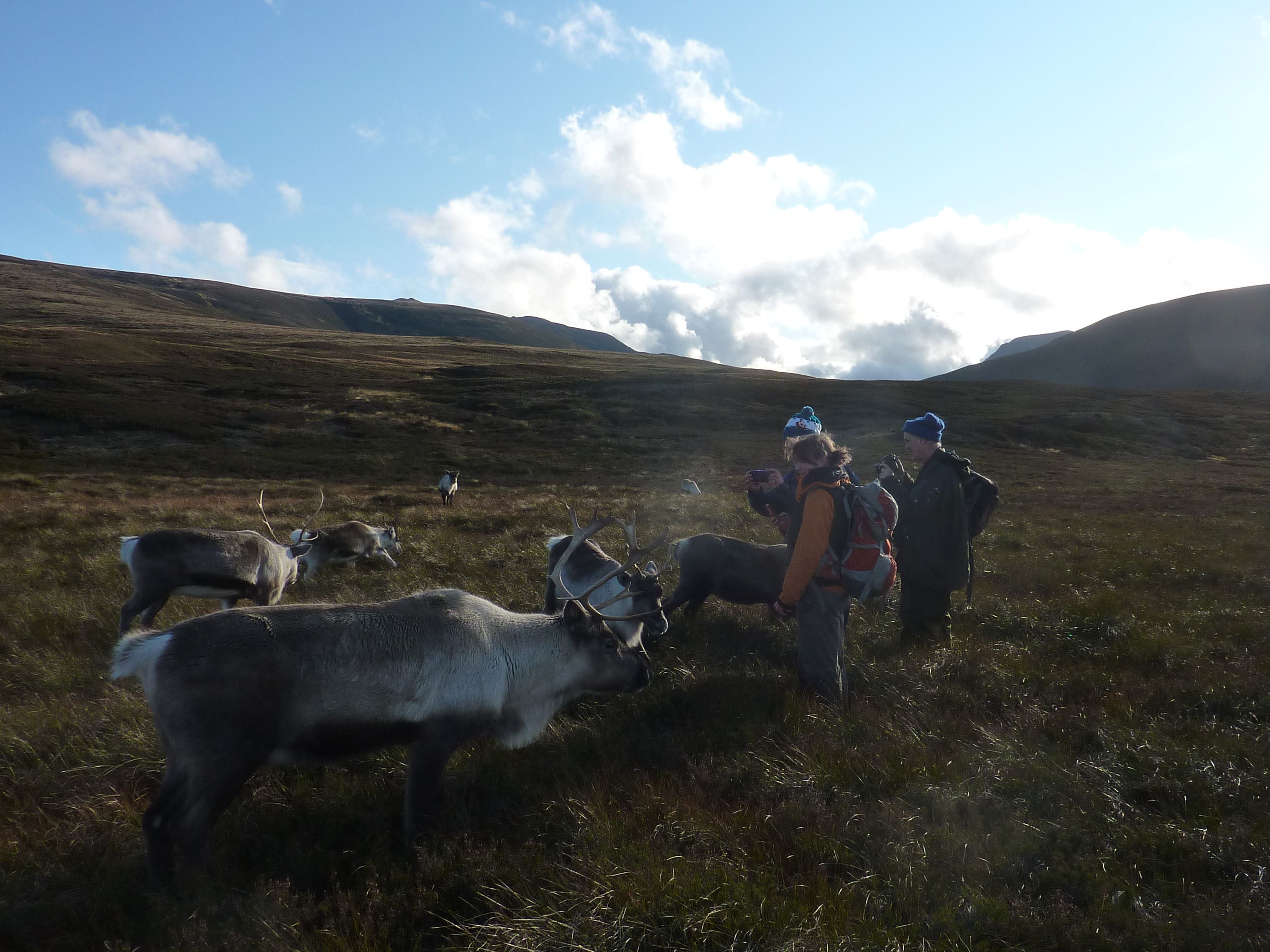
- Ron uses his special reindeer communication skills to call them over to meet Rachel and CJ
-
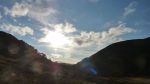
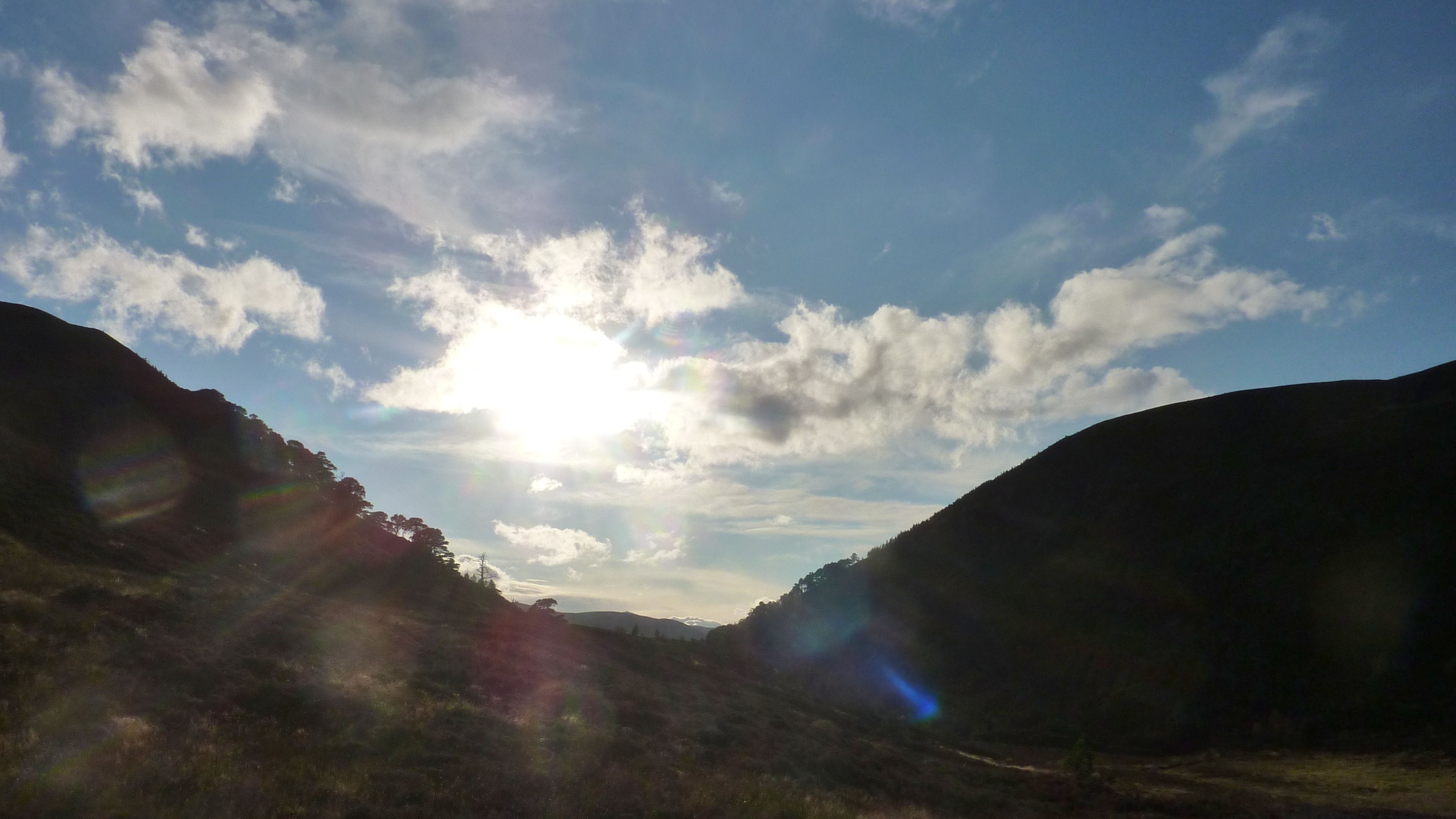
- Looking South into Glenmore FCS estate
Reserve work…
Just to give you an idea of what I’m up to… Yesterday myself, Alice, the two short-term vols (Andy and Andy), and Gregg, who’s on secondment from the RSPB Scotland office created deadwood in the morning. This involves killing trees (generally pine) in a plantation in a variety of ways, to give space to broad leaf trees or granny pines and let light through to the forest floor.
As I have a chainsaw I ring bark trees, damage them (so they are more susceptible to being blown over), or high stump them. The non chainsaw folk are, meanwhile, pulling trees over with a winch, or ‘totem polling’ them. The aim is to leave the majority of the deadwood standing, as this generates invaluable woodland habitat for birds and invertebrates. It sounds harsh, but the plantation is densely packed, and we can create a lot of deadwood by working on just a small percentage of the trees.
In the afternoon we strengthened a fence around an experimental regeneration enclosure. I then had to rush back to the lodge to enter the Osprey satellite tracking data for the week. The news on that front is that the two young that we’re tracking have both made a successful trip to Western Africa, and appear to be fishing and hanging around on the rivers in that part of the continent.
Today, myself, Gregg and the two Andy’s accompanied Bob (one of the wardens) to Craigmore wood, another part of the reserve, where we checked the fence and removed rogue Norway spruce from the site. We also checked fences near Mondhuie and Lyngarrie.
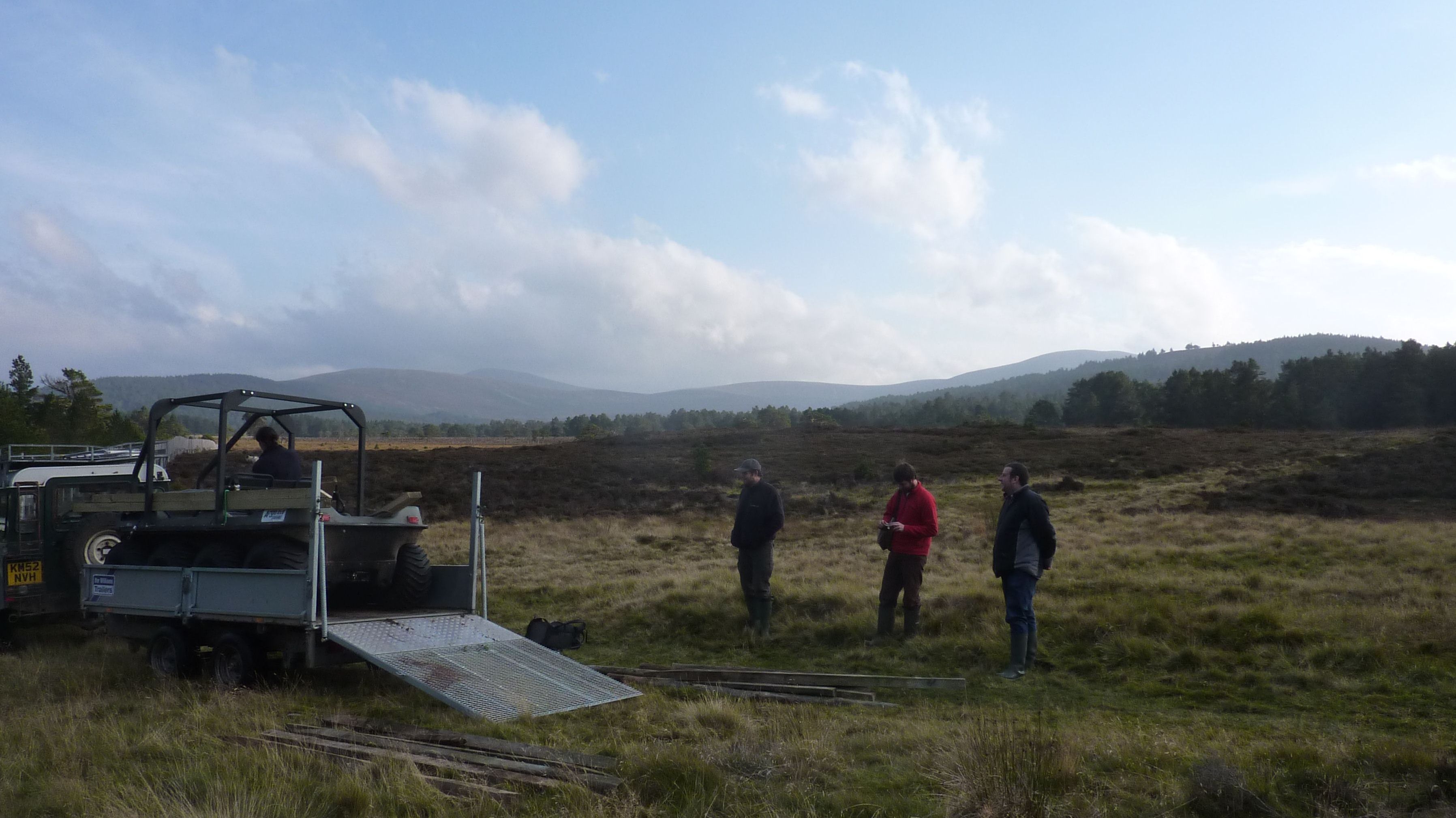
From left to right, Alice, Gregg and the two Andys.
Mar Lodge with team Pine Marten
Laura Kubasiewicz and David Bavin are currently staying at Forest lodge while they research the habits of local pine martens for Laura’s PhD. Having collected data from Abernethy they are now collecting hair tube (a tube that the pine marten climbs up to get bait and in the process leaves hair on a strategically positioned sticky pad) and scat samples from Mar Lodge. I was lucky enough to tag along with Laura and Dave for the day to see Mar Lodge and get a bit more experience in collecting samples (with blue sterile gloves on)
Mar Lodge is a massive estate owned by the National Trust. At first sight it seems idyllic, with beautiful fast flowing burns and stately granny pines mixed with the odd colourful larch. However, a little more thought and I realised that all is not so well on the estate. There are a good number of snags (standing dead trees, in this case scots pines, likely to have died in the last 50 years), and some fallen dead wood, and there appears to be very little significantly sized regeneration. Having said that, it appears that the National Trust Scotland (NTS) are on the case. They have recently opened up their management plan for consultation and the reduction in deer numbers over the last 5 years has started to lead to significant changes in the ground flora, and an increase in seedlings.
As for the pine martens, we found lots of scat and some hair in one of Laura’s hair tubes. Pine martens have quite big territories, but Laura can find out how big by genetically testing the hair from the hair tubes. This allows her to determine individuals and their gender.
-
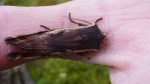
- This red sword grass (Xylena vetusta) was hiding in one of the hair tubes.

-
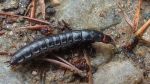
- A beetle larva, possibly ground (carabid) beetle.

-
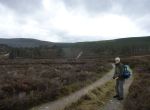
- Laura at Mar
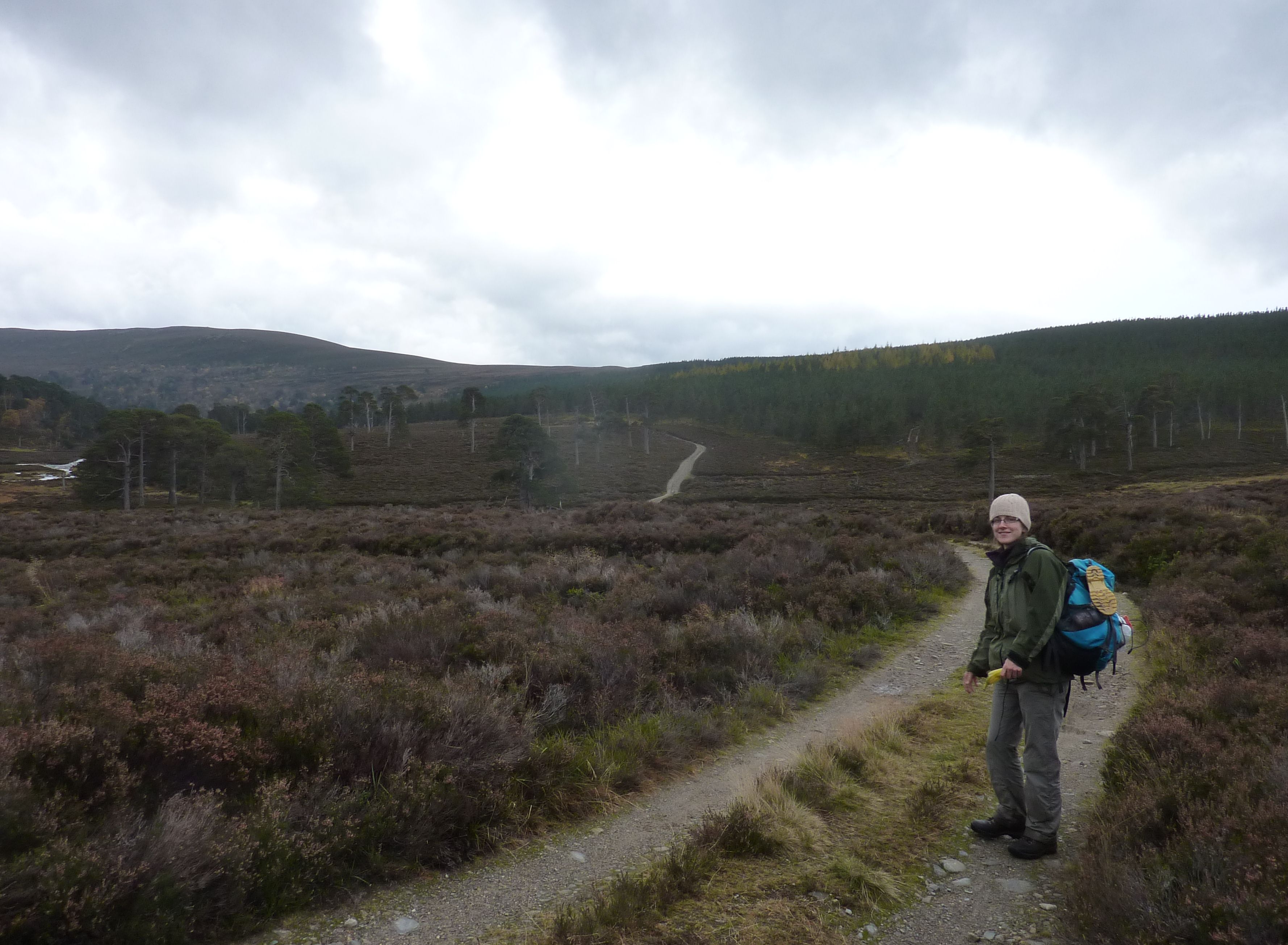
Trees for Life week at Plodda Lodge and Glen Affric, 15th – 22nd Oct
I’ve just finished Focalising the last ever TFL week at Plodda Lodge. Over the last two years Plodda has become my favourite TFL accommodation. For me it has a very intimate feel with a communal eating area and a single bunk room. It’s funny, I can remember avoiding it during my early volunteer weeks, because I was put off by the idea of a single bunk room, but due to some last minute changes to the work week schedule in early 2009 I was asked to go there for my first week as a Focaliser. I was joined on the week by some good friends, from TFL and some I knew outside of the organisation, and I can remember lying in the bunk room one night, listening to everyone breathing/shuffling/talking in their sleep (a couple of them seemingly talking nonsense to each other!), and thinking that I felt an incredible feeling of well-being in amongst them.
During this week we carried out non-native tree weeding on three of the days, removed a few hundred metres of fencing on a wet day at Kerrow wood, and spent a day in the nursery. One of the weeding sites was alongside Loch Affric, which is in a fantastic, rugged setting. On our last day there we took the opportunity to visit the Athnamulloch bothy, a place that TFL have used for work weeks in the past.
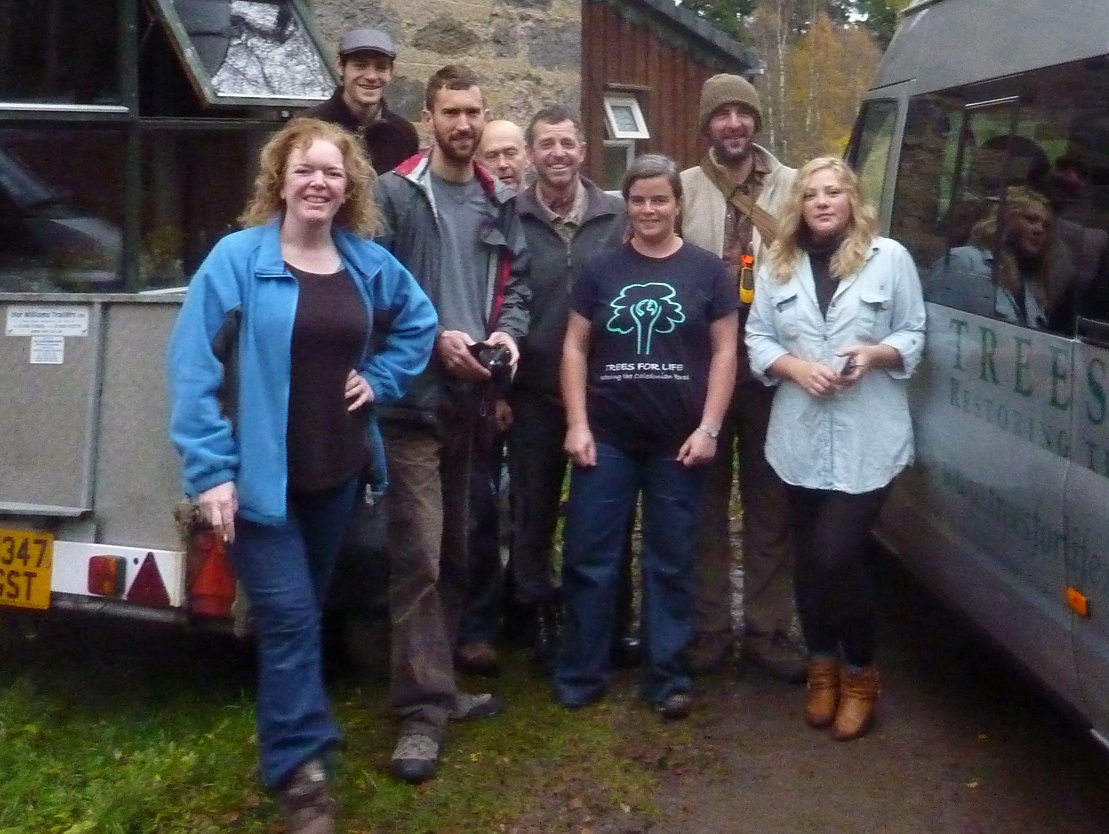
Special thanks to Mick, my co-focaliser, and to Gordon and Julie for their support during the week. In some ways this was the most interesting week I’ve spent with TFL, and I’m grateful that I was able to share it with such a considerate group of people.
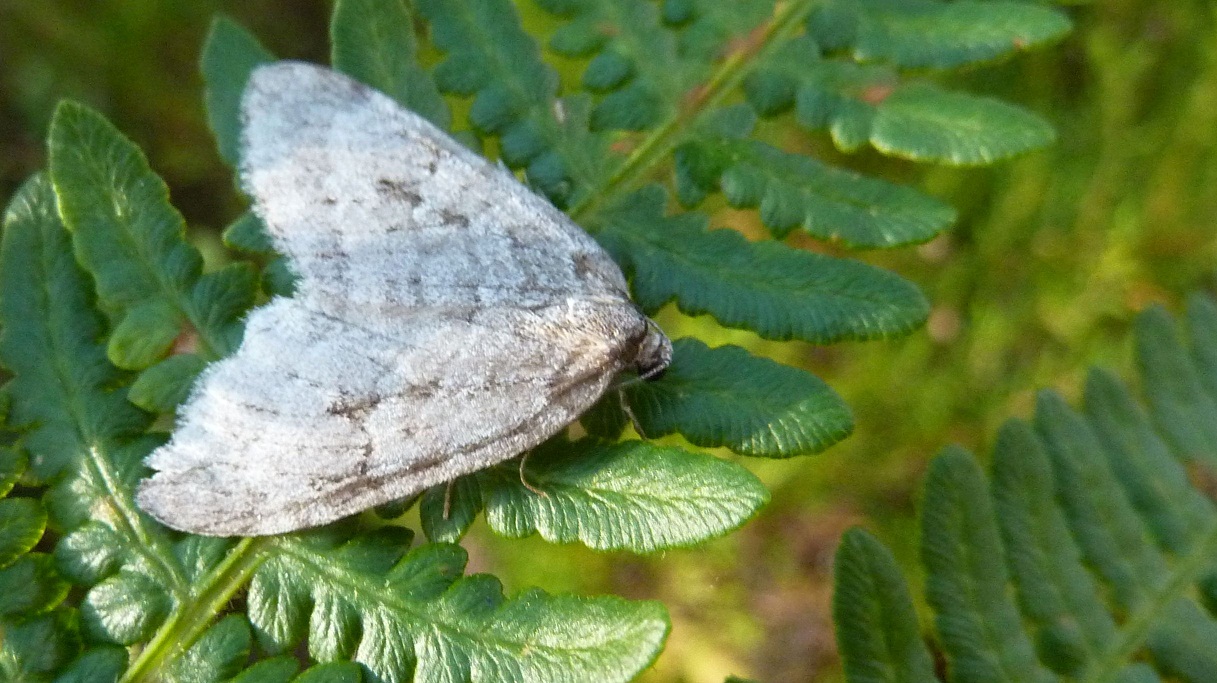
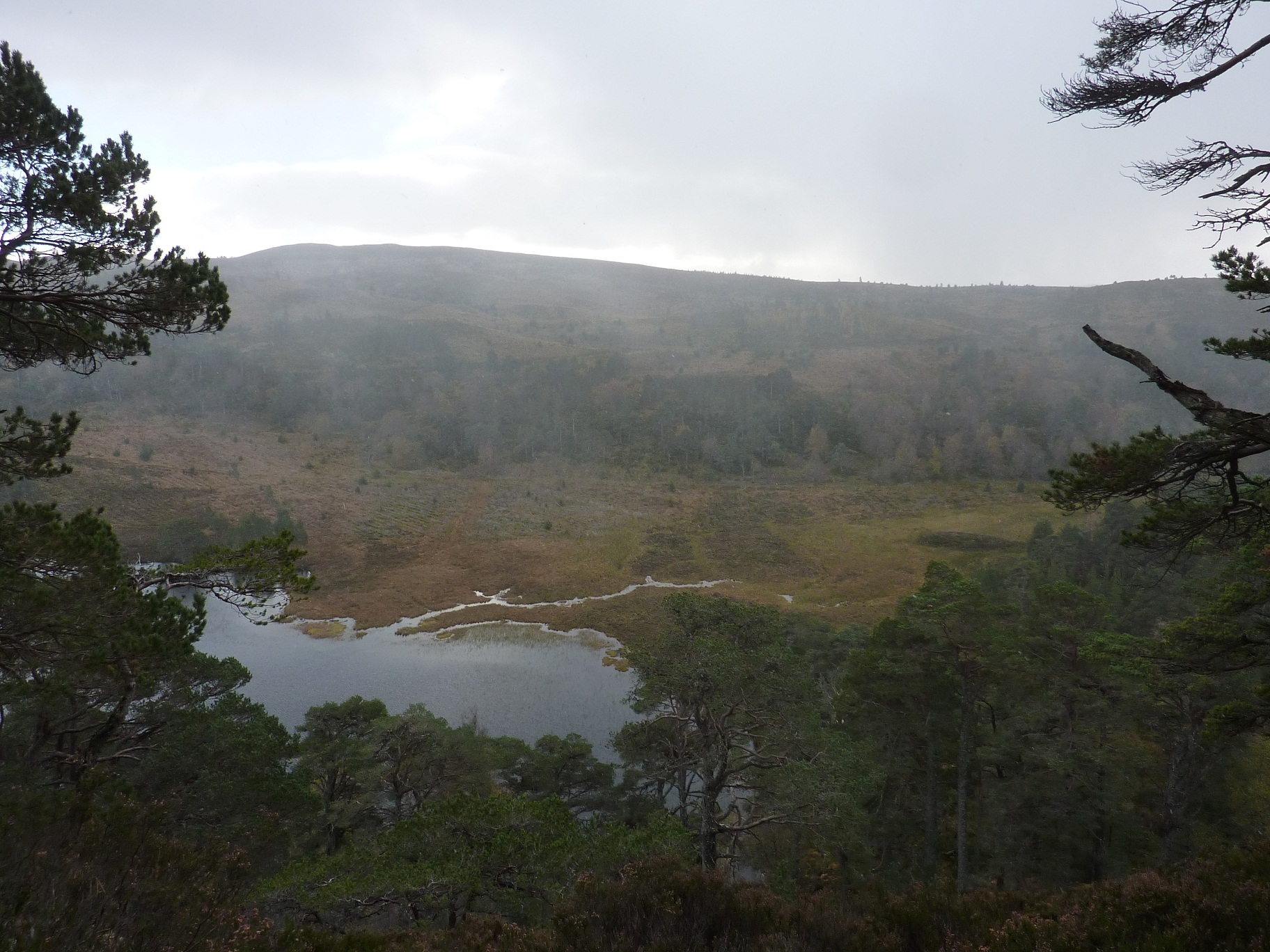
I look forward to catching up with the trees from the nursery in a couple of weeks at Dundreggan. Here are some photos from the week. Not many nature ones I’m afraid, as it’s pretty hard to tell if I’m taking a decent picture without an lcd screen or viewfinder on my disabled camera. The ones of Plodda falls and from the hills up near Loch an Eang are taken on our day off.
-

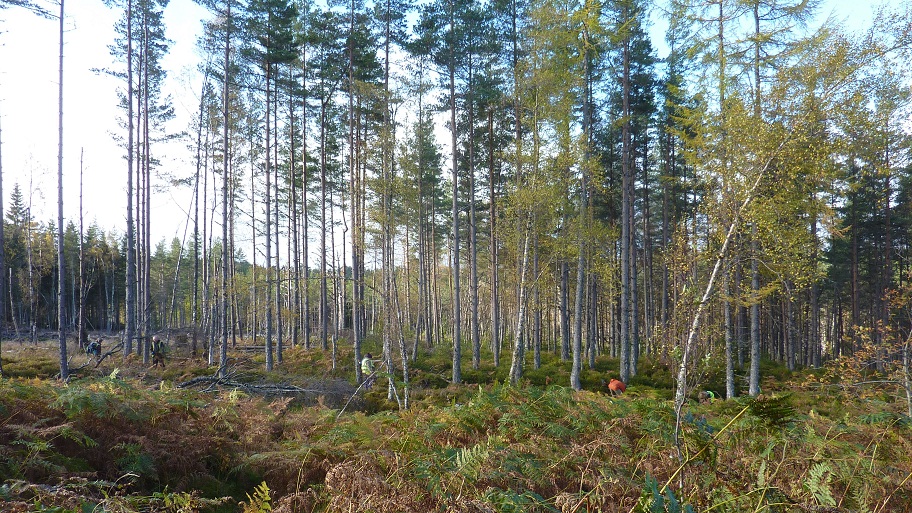
- Pulling ‘exotics’ out from under native tree species
-
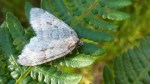
- Autumnal moth (Epirrita filigrammaria)
-

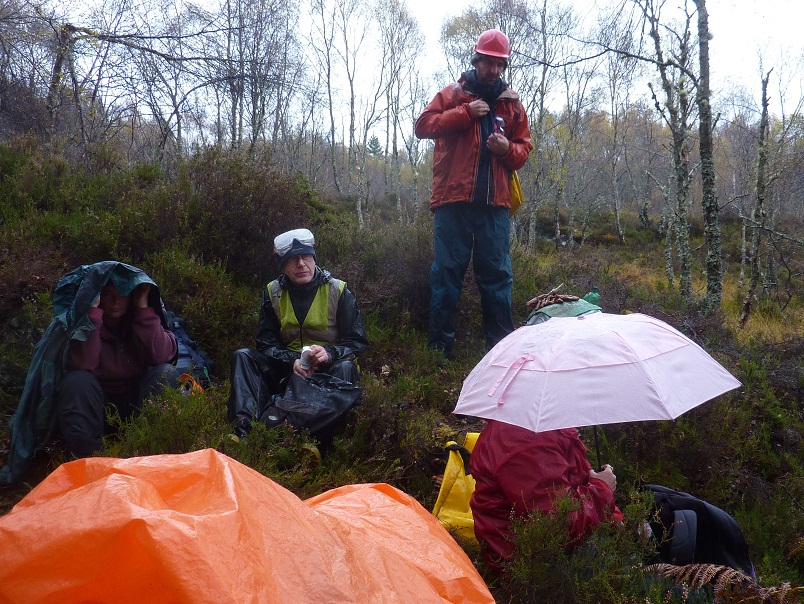
- Tina sports the first umbrella I’ve ever seen on a work week
-

- The fine weather continues during our day in the nursery

-
- Plodda falls
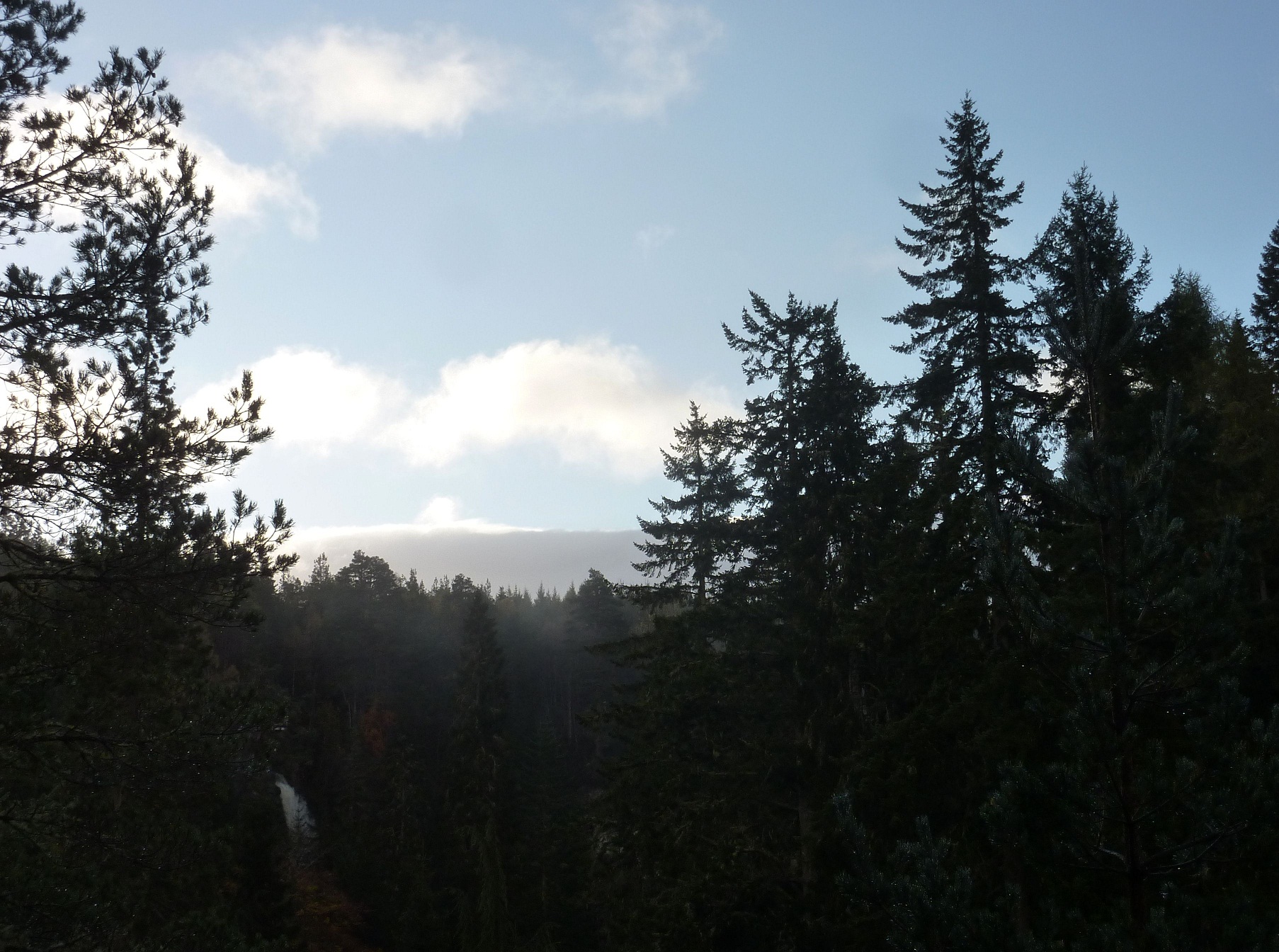
-

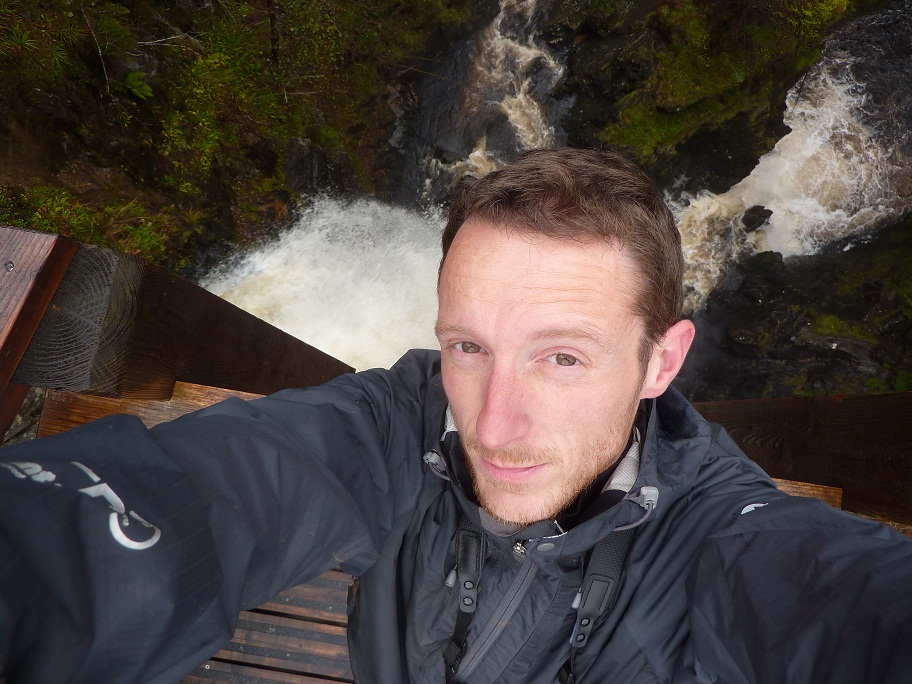
- The blogger demonstrates significant courage to hang his head over a sizeable drop
-
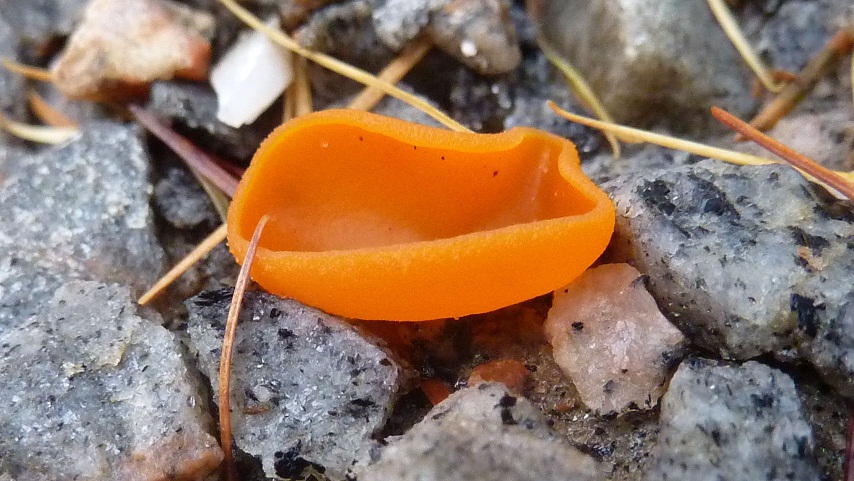
- Orange peel fungus (Aleuria aurantia)
-
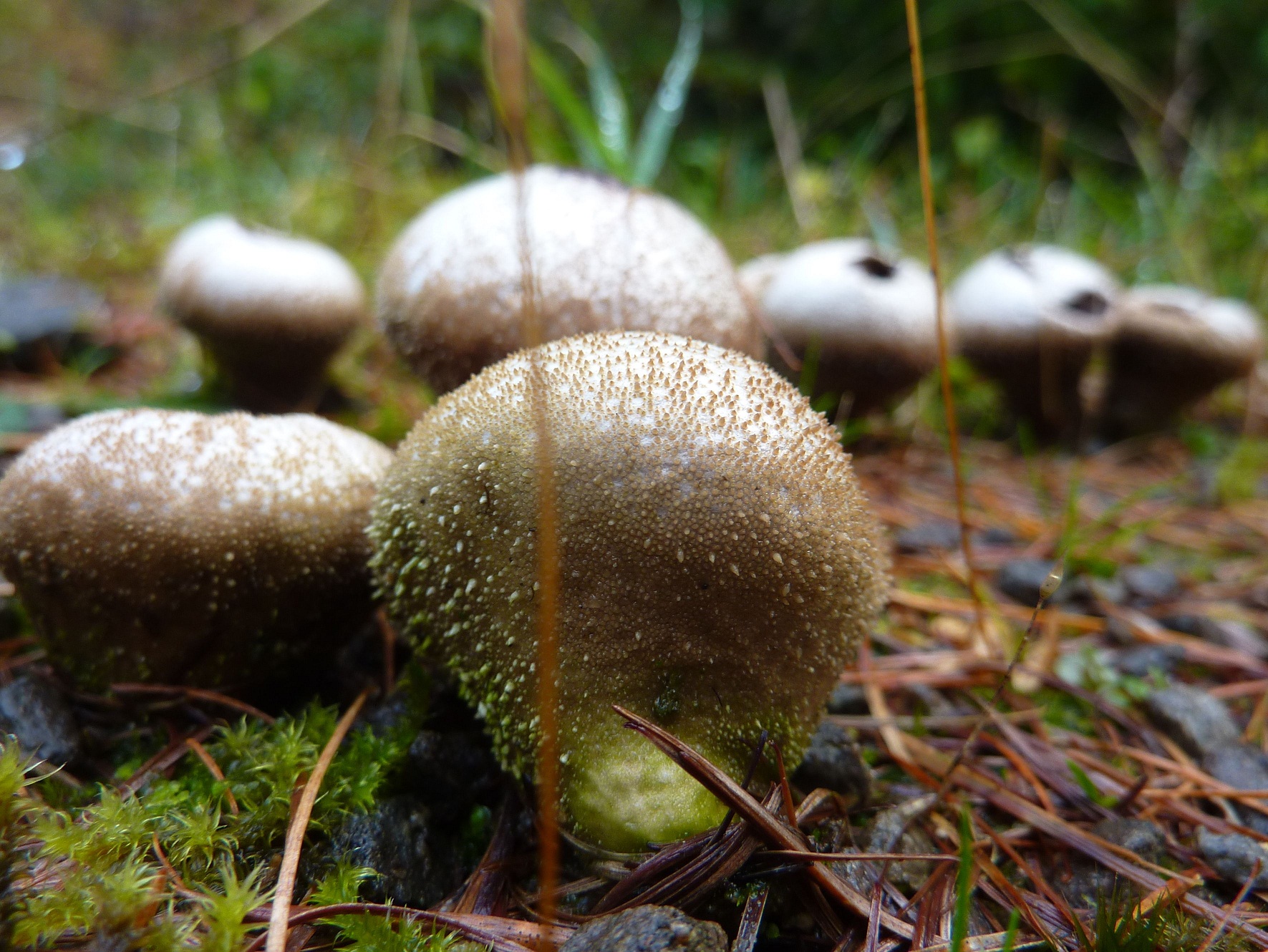
- Common puffball (Lycoperdon perlatum)
-
- Ha, I almost fell asleep here on my day off. When I looked up it was snowing
-
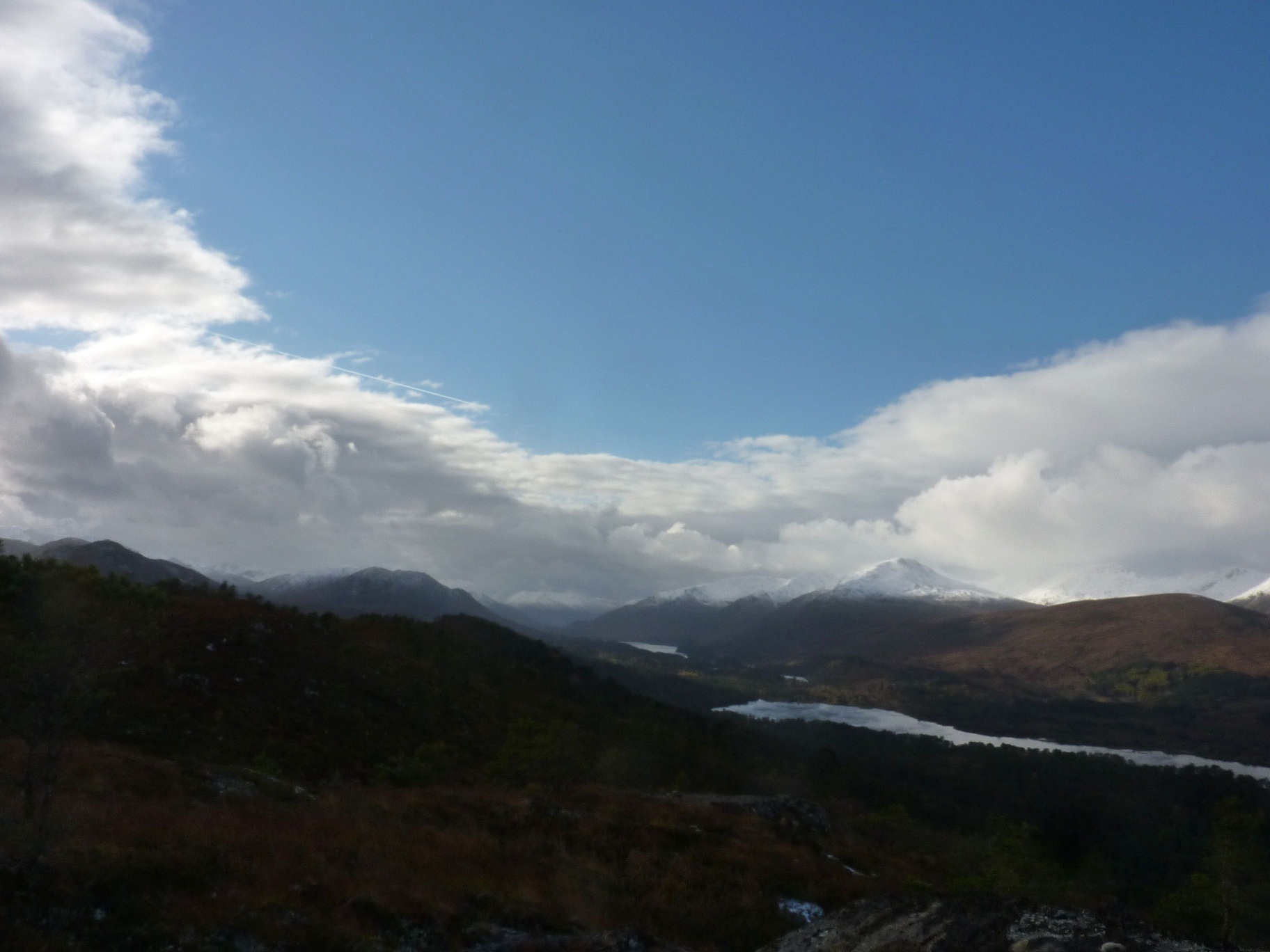
- Glen Affric
-
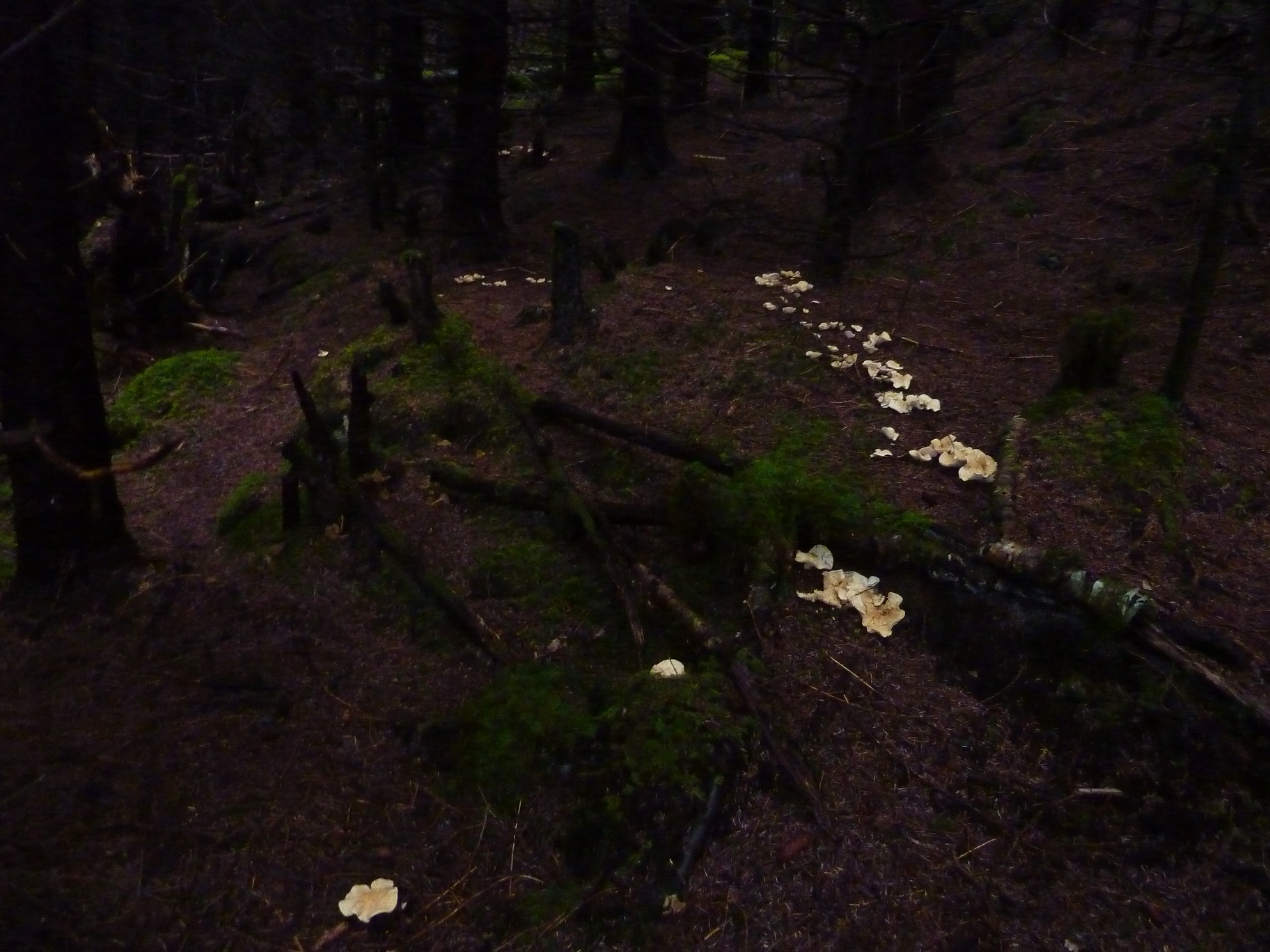
- Where the wood fairies have been dancing
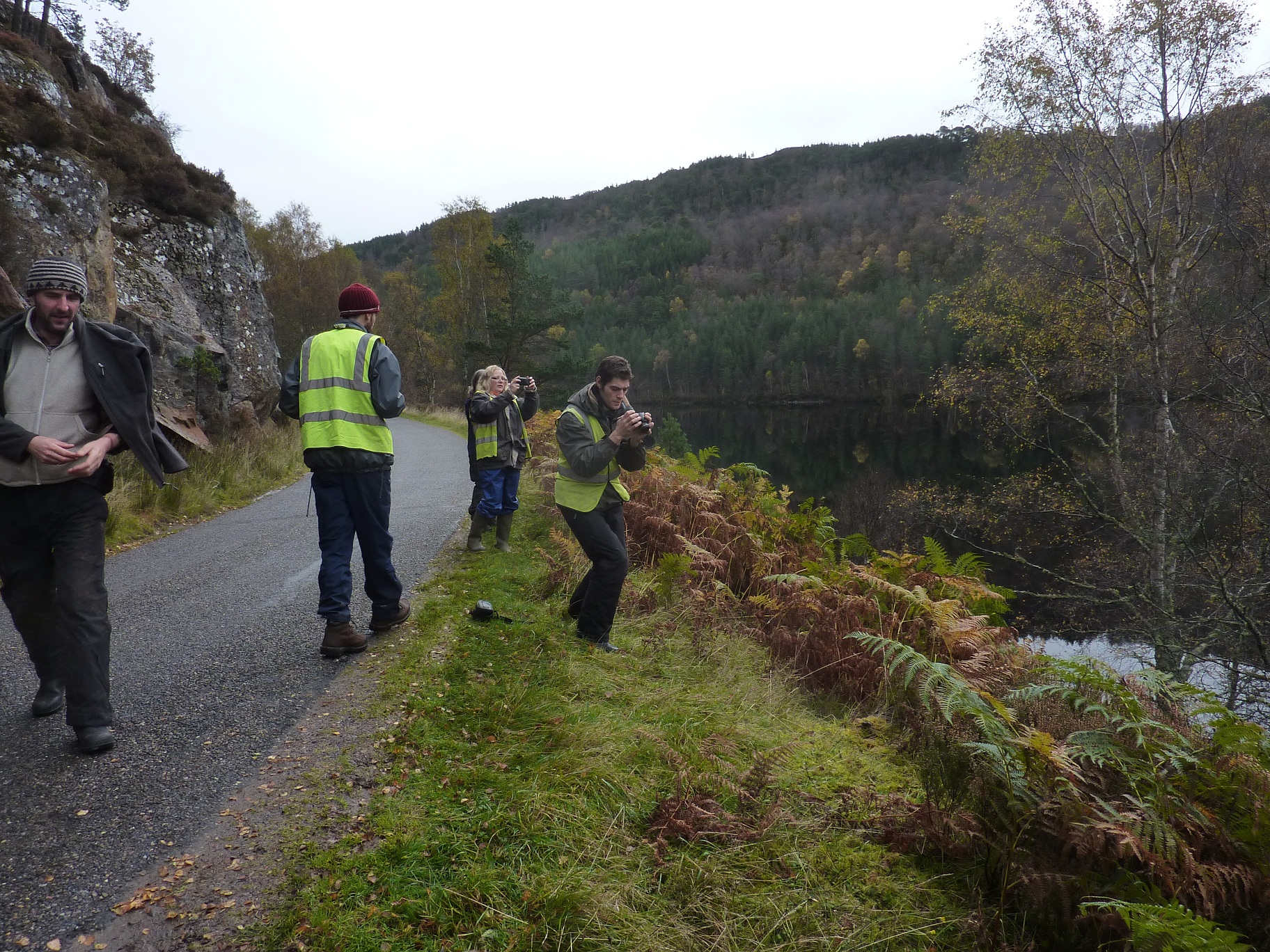
-
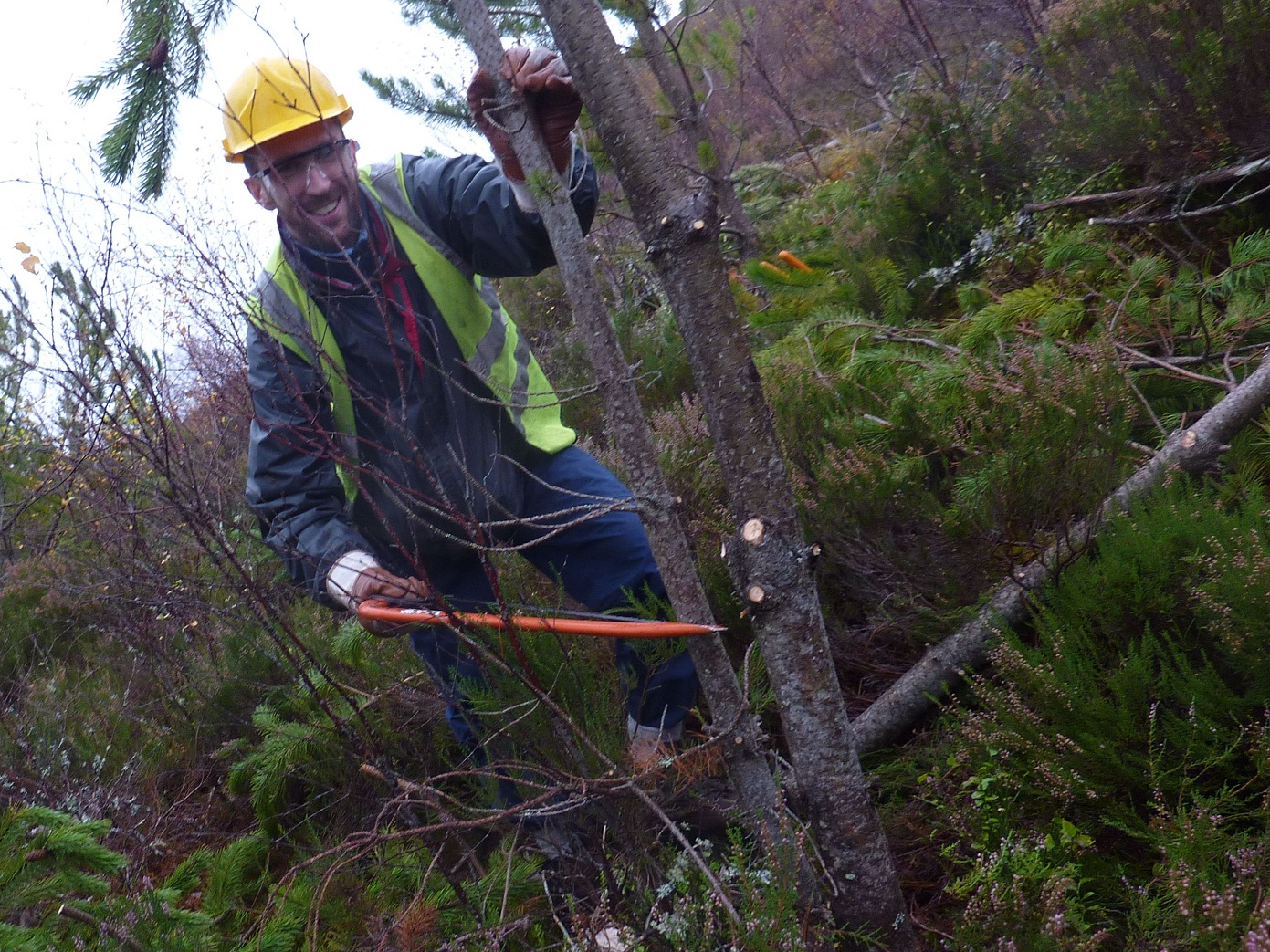
- Neil Kirkwood is available for all types of outdoor photoshoots
-
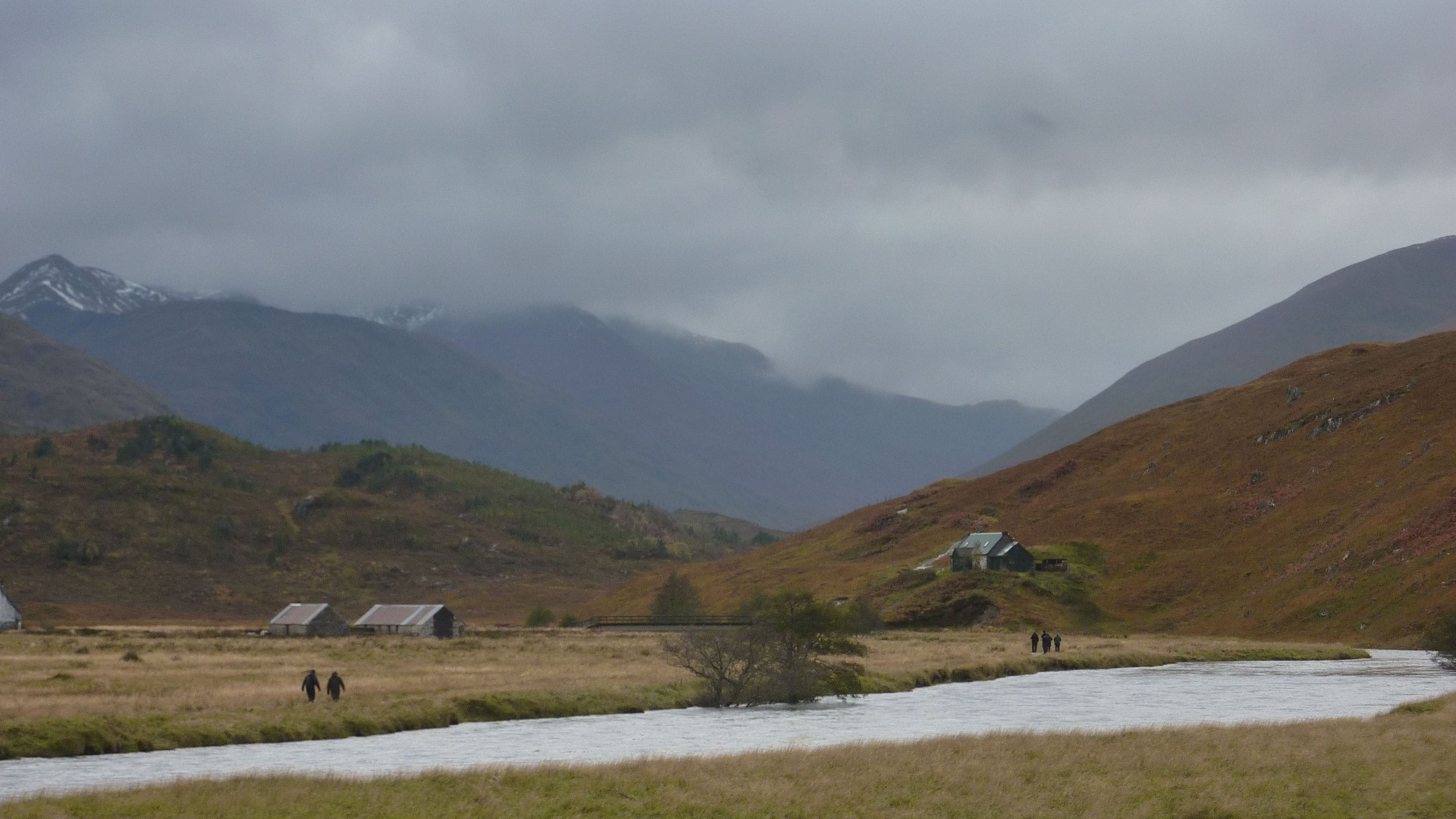
- Athnamulloch
-
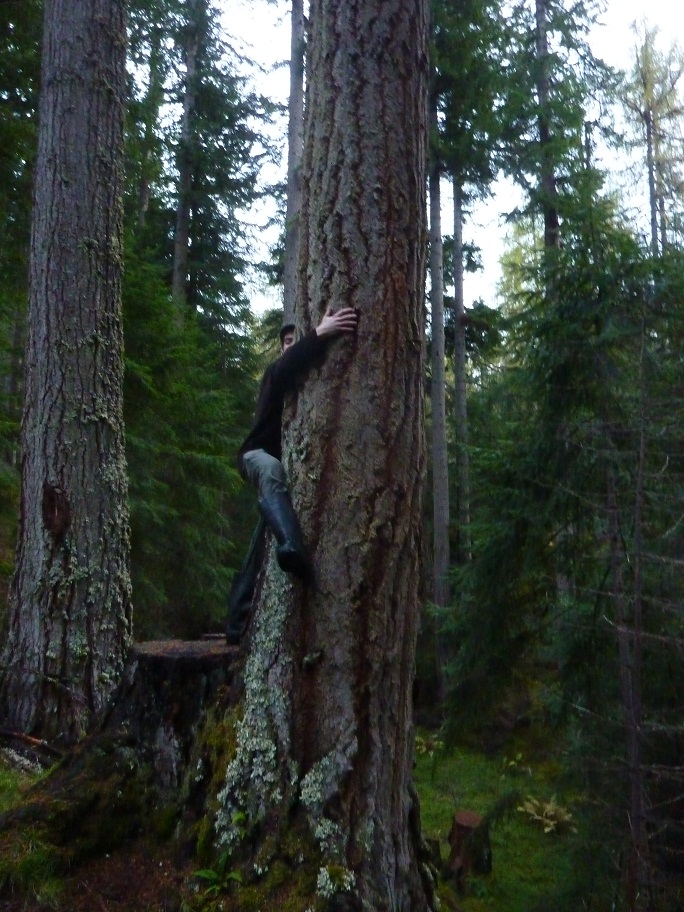
- After half an hour Chris has nearly climbed to the top of the tree
-

- There are 3 of these shots, and this is the least funny, but at least we look fairly normal
The dam builders
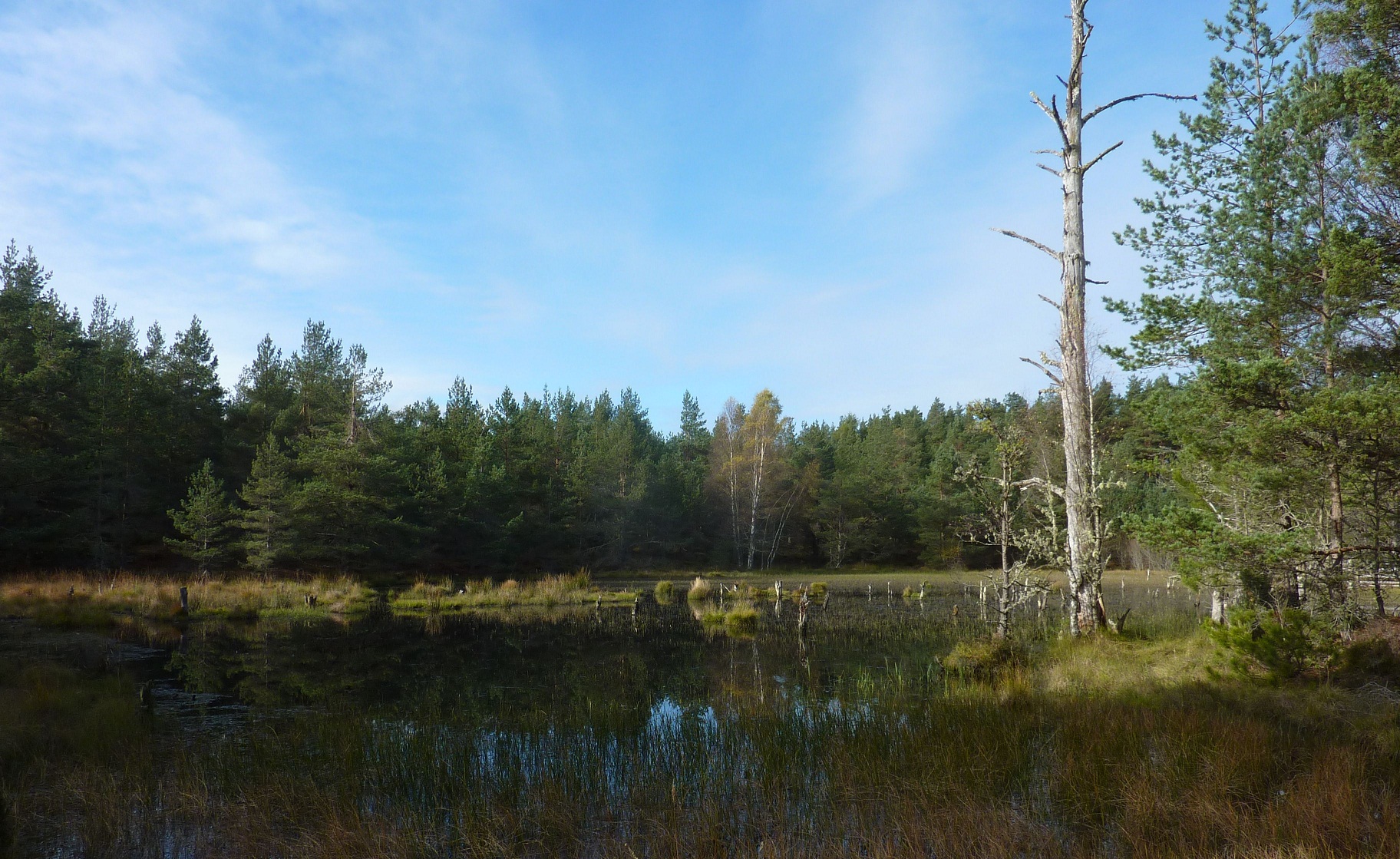
Ross has kindly given me two projects to look after while I’m here at RSPB Abernethy. One is to manage the roadside regeneration on one of the woodland tracks (Mondhuie), and the other is to build a series of dams to block some drainage ditches. The ditches were dug shortly after world war two when trees were in short supply and much of the land was being used to produce a timber crop. Now the RSPB are restoring the area, near Loch Garton, to it’s original bog wood habitat, to help the many species that live there.
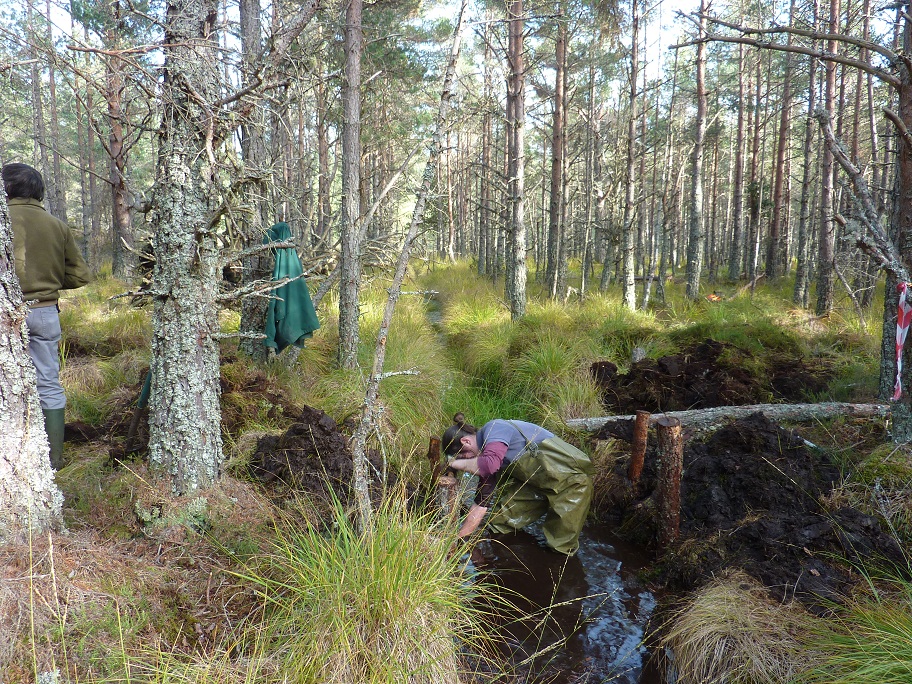
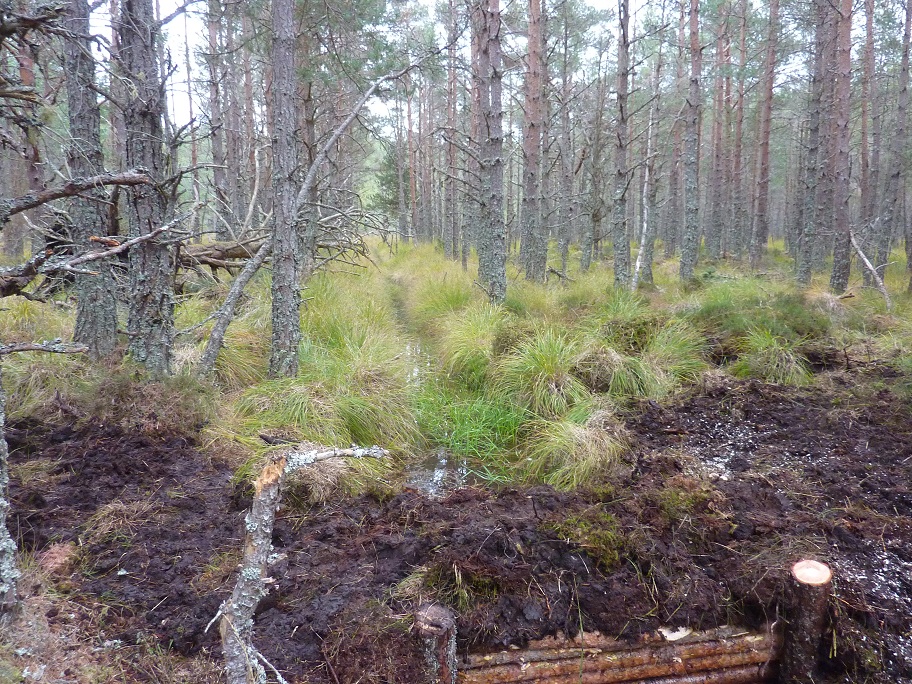
It just so happens that dam building is a good team sport. One person gets to put on a large pair of waders and stand in the ditch while the others dig turf, saw up some wood for the structure, stand in the plastic lining, and generally help pack the dam with peat and turf. It’s also great to be able to see the results as the water level rises behind the dam.
-
- The Dragonfly Loch
-

- This is likely to be the only time I see Alice in waders.
-

- Dam fine.
Abernethy strikes back…
I’ve been here for almost two weeks now, and so far I’m down a mobile phone and half a camera. Whilst out walking on my first weekend at the reserve it rained a lot and I mistakenly took my mobile from my pocket a couple of times to check the time. Alas, on one of these inspections the screen went blank and the phone has not worked since, despite then spending 3 days on a radiator.
On Monday I was out with Ross Watson, Operations Manager and one of the wardens here, and we had to do a fair bit of walking about in rocky burns, and when I next pulled out my camera it became apparent that the LCD screen had taken a knock. This makes photography somewhat more exciting as I’m now unable to see what the picture is like that I’m taking with the camera, and I have to wait to download it onto my laptop to view.
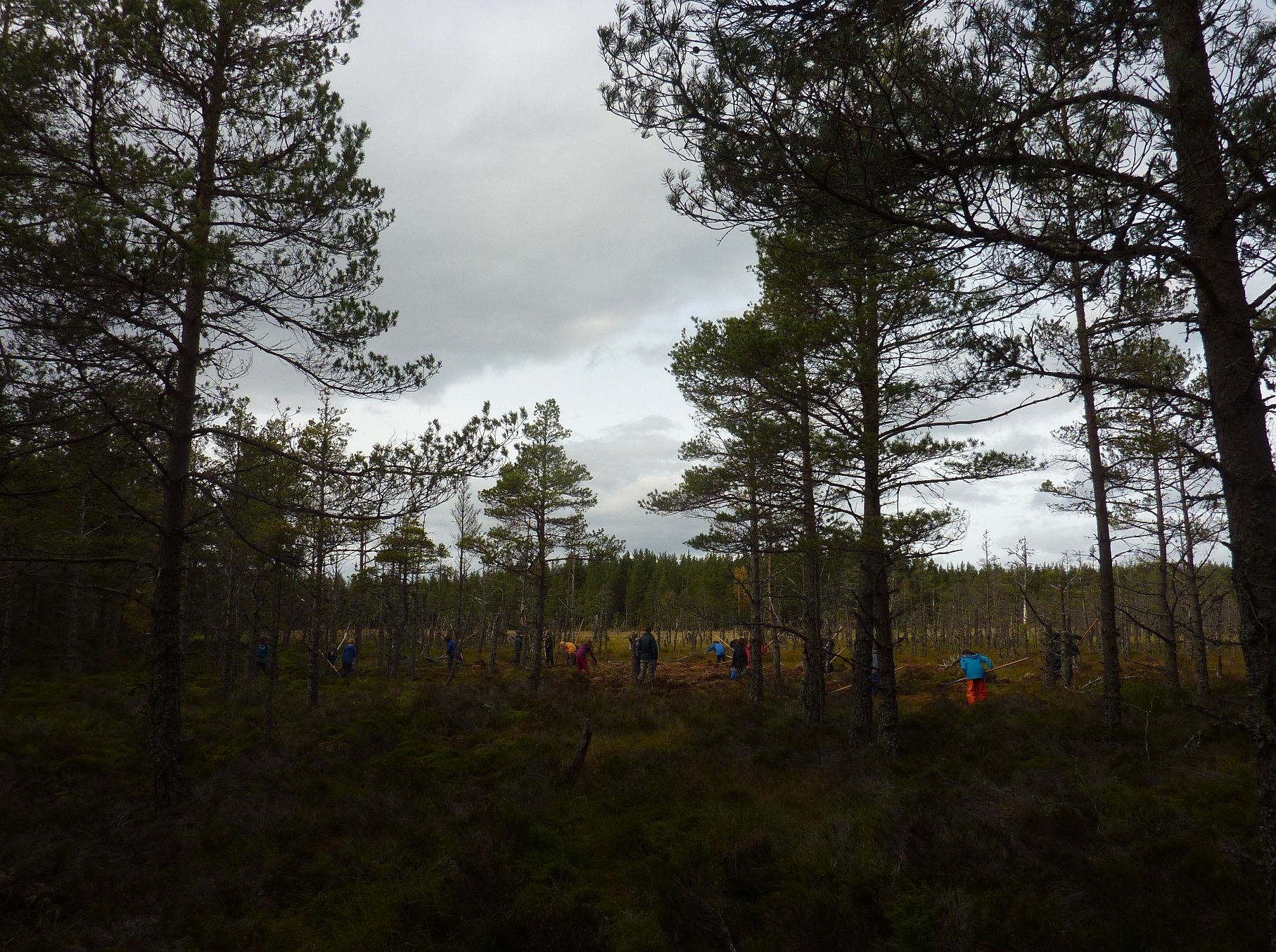
Last week duties included spending a day with the pupils from Grantown Grammer School carrying out non native tree removal and creating dragonfly ponds, and cutting wedges out of older scots pine with RSPB Scotland’s senior research biologist, the brilliantly knowledgeable Ron Summers. Ron is working with a student from St Andrews to identify when fires took place across the reserve. To do this Ron first identifies a tree with a fire scar (see picture below) and the wedges that I cut from the trees are then analysed as the rings show both the age of the tree and in which years the fires took place.
I was also lucky enough to spend two days on a 4×4 course in Aviemore. Many thanks to Andy Burnett for his skill and patience. Now I just need to get a 4×4 vehicle stuck on a steep slippery hill to practice some of the techniques (quickly stick it in reverse, accelerate back down the hill, it goes against everything my nerves tell me to do…).
Ok, enough waffle, time for some pictures (mostly taken while I could still see what I was taking pictures of)…
-
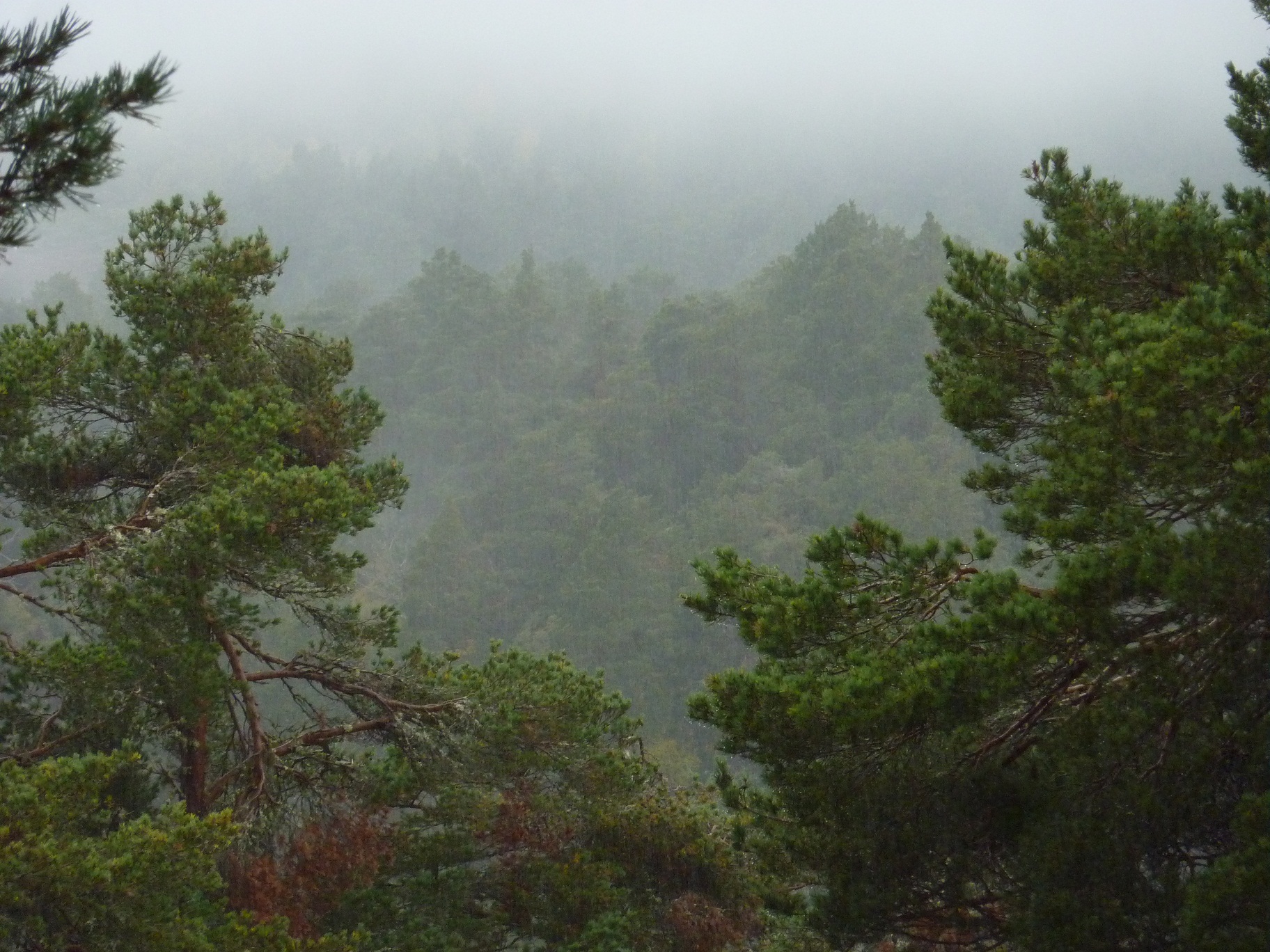
- This weather destroyed my mobile.
-
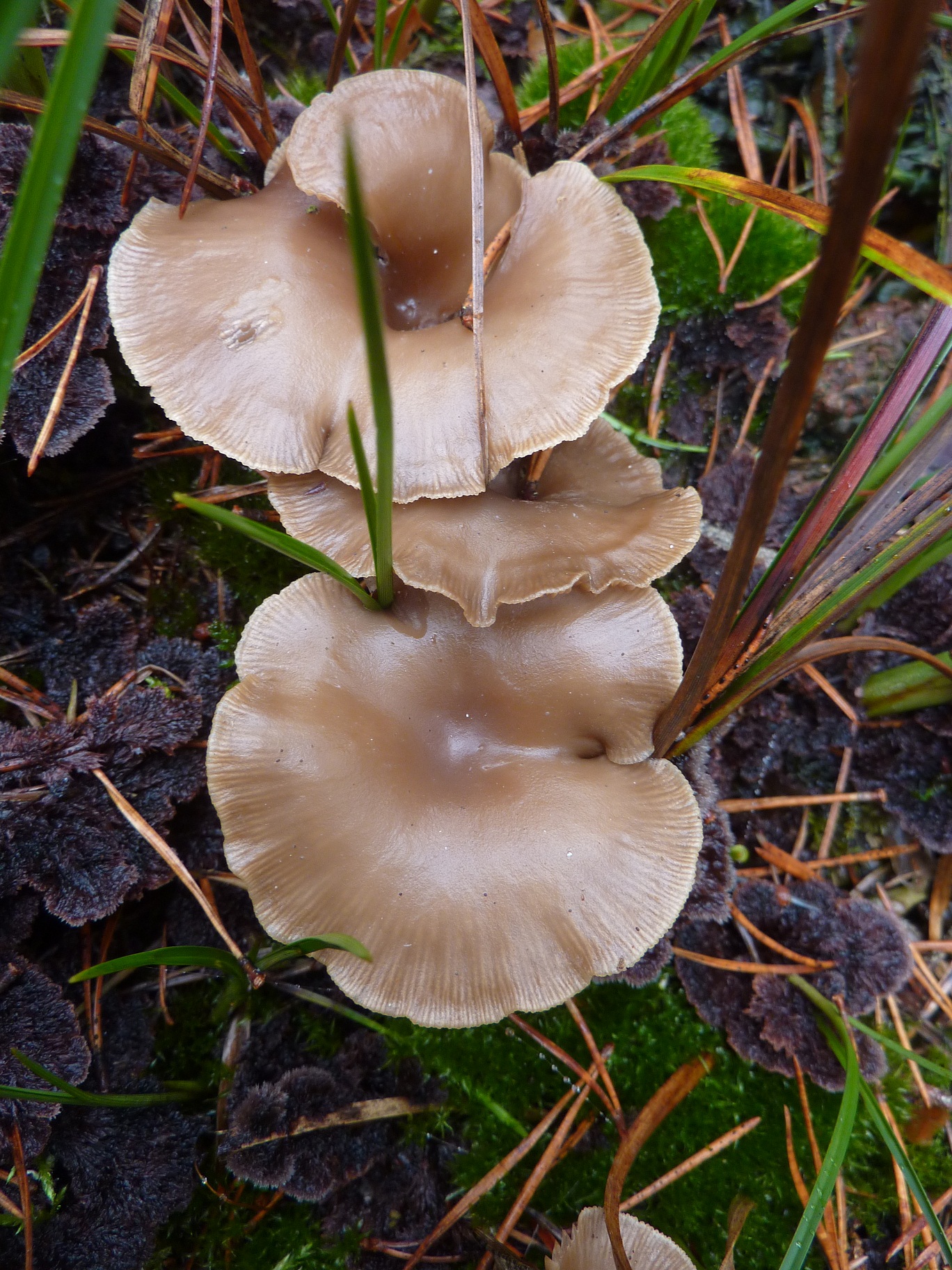
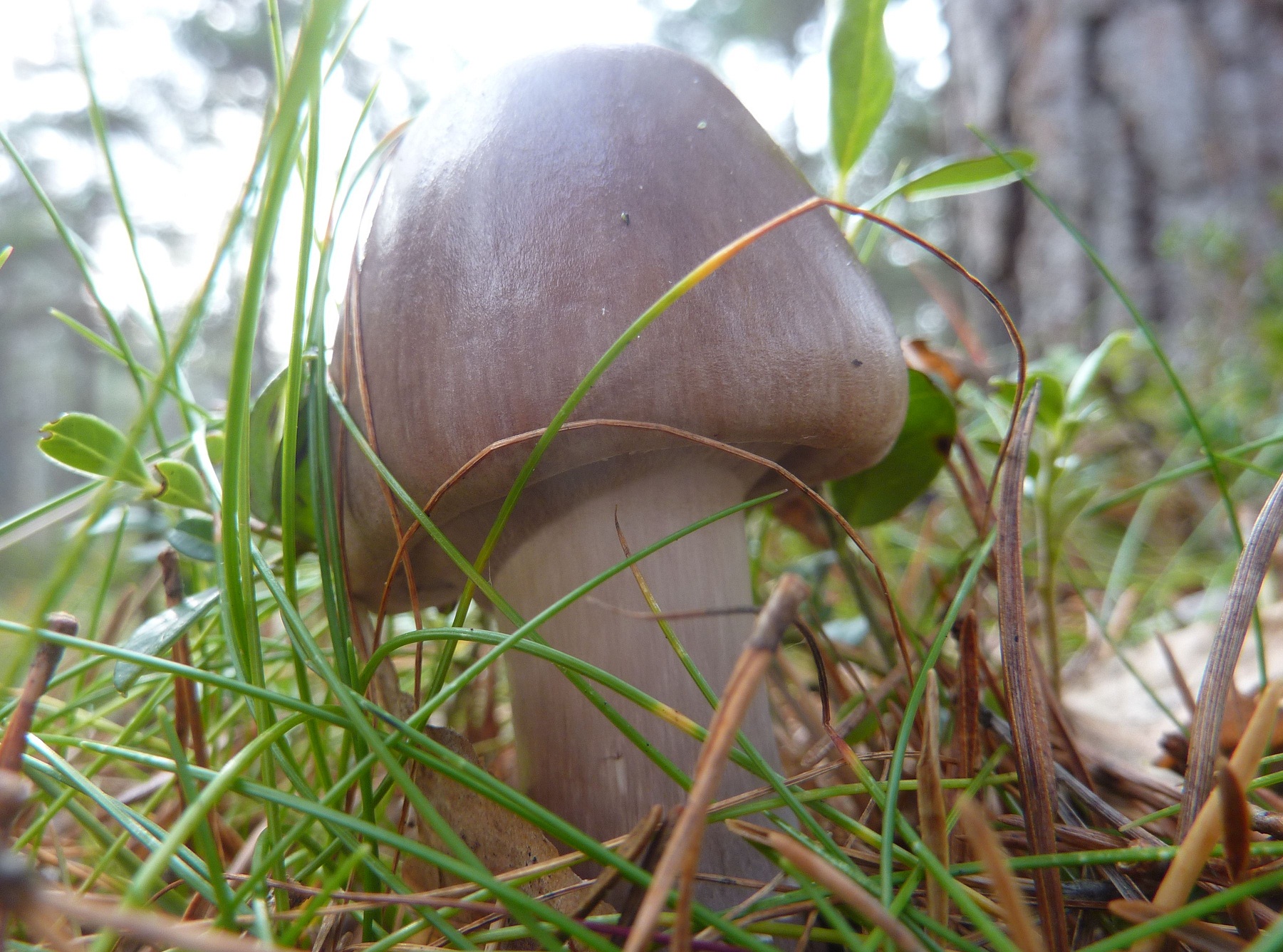
- Can’t believe I can’t identify this…
-

- …or this. Any help would be much appreciated.
-
- The Grantown kids using weed rakes to create dragonfly ponds
-
- Before they all fell out…
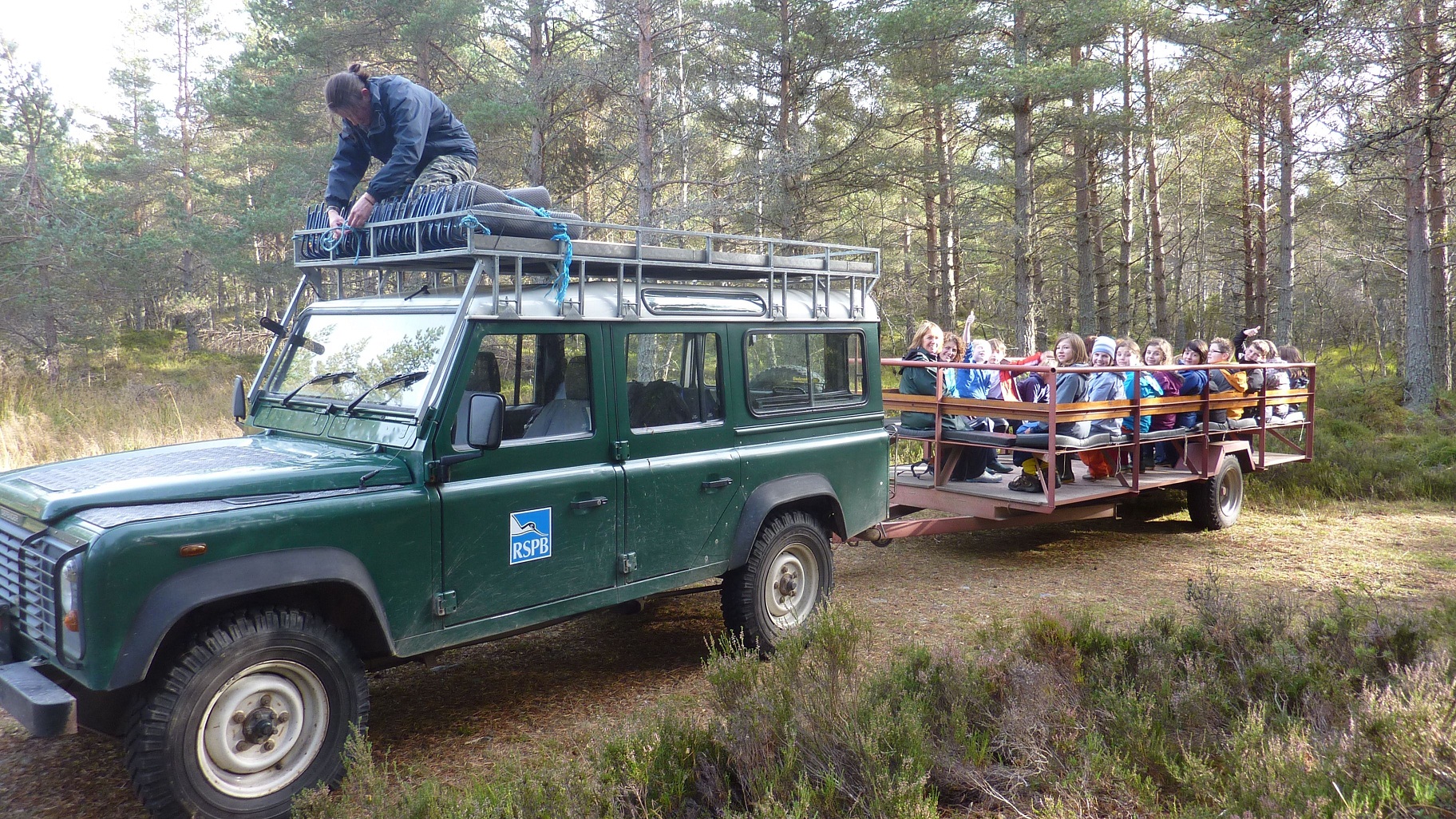
-

- Forest Lodge
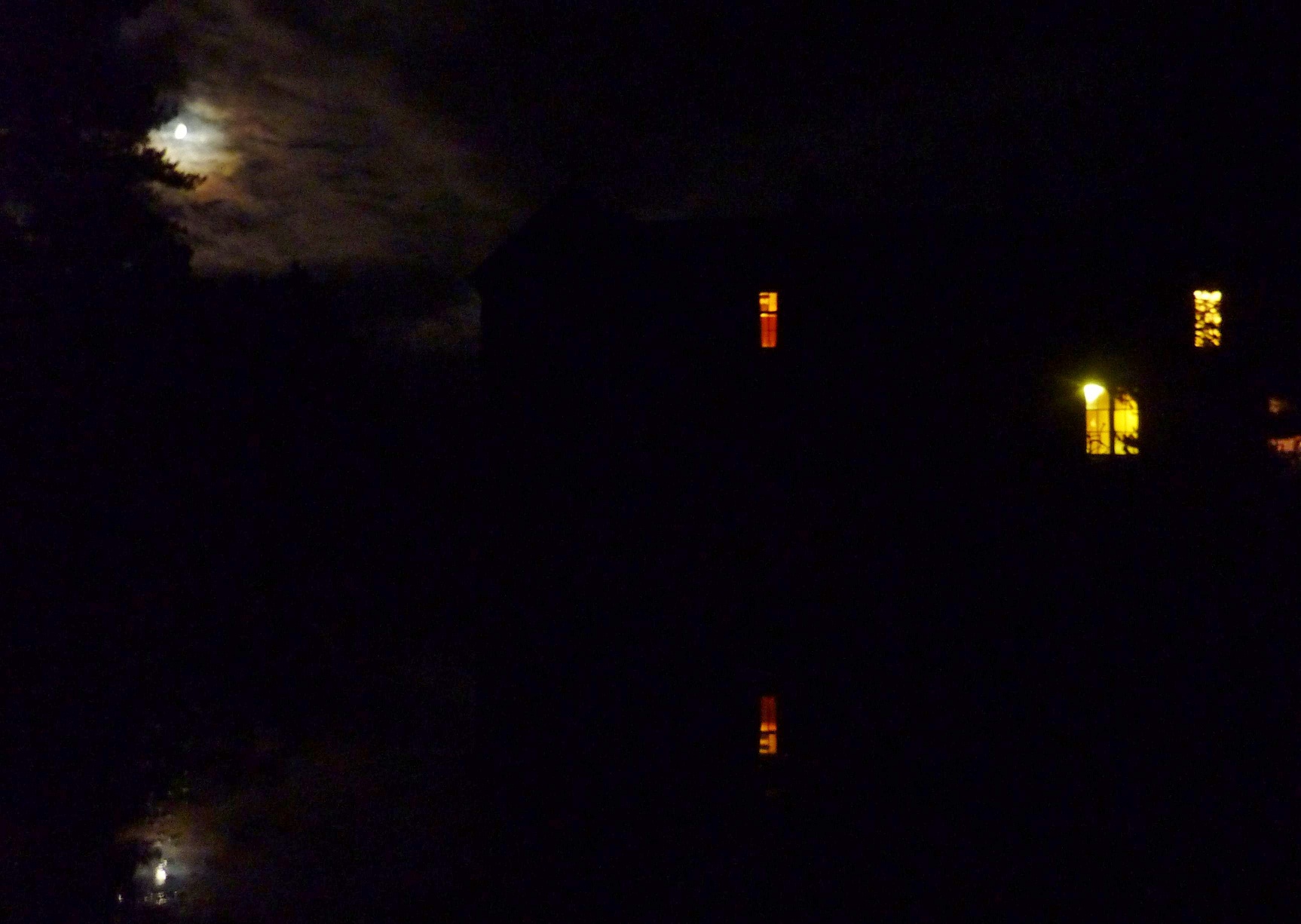
-

- Ron examines the wooden wedge for fire scars
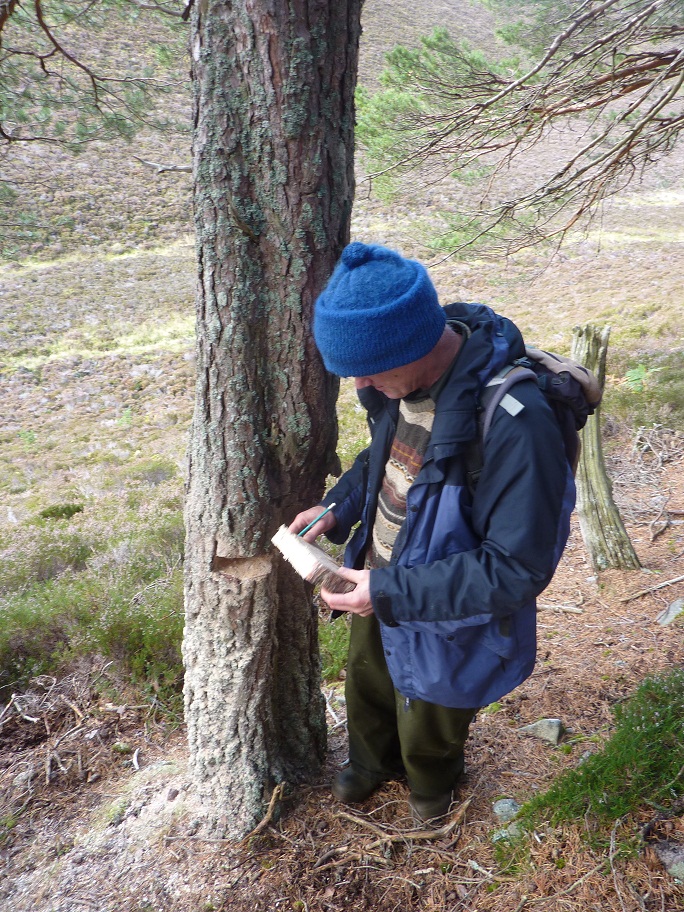
-
- Allt Clais an Eich
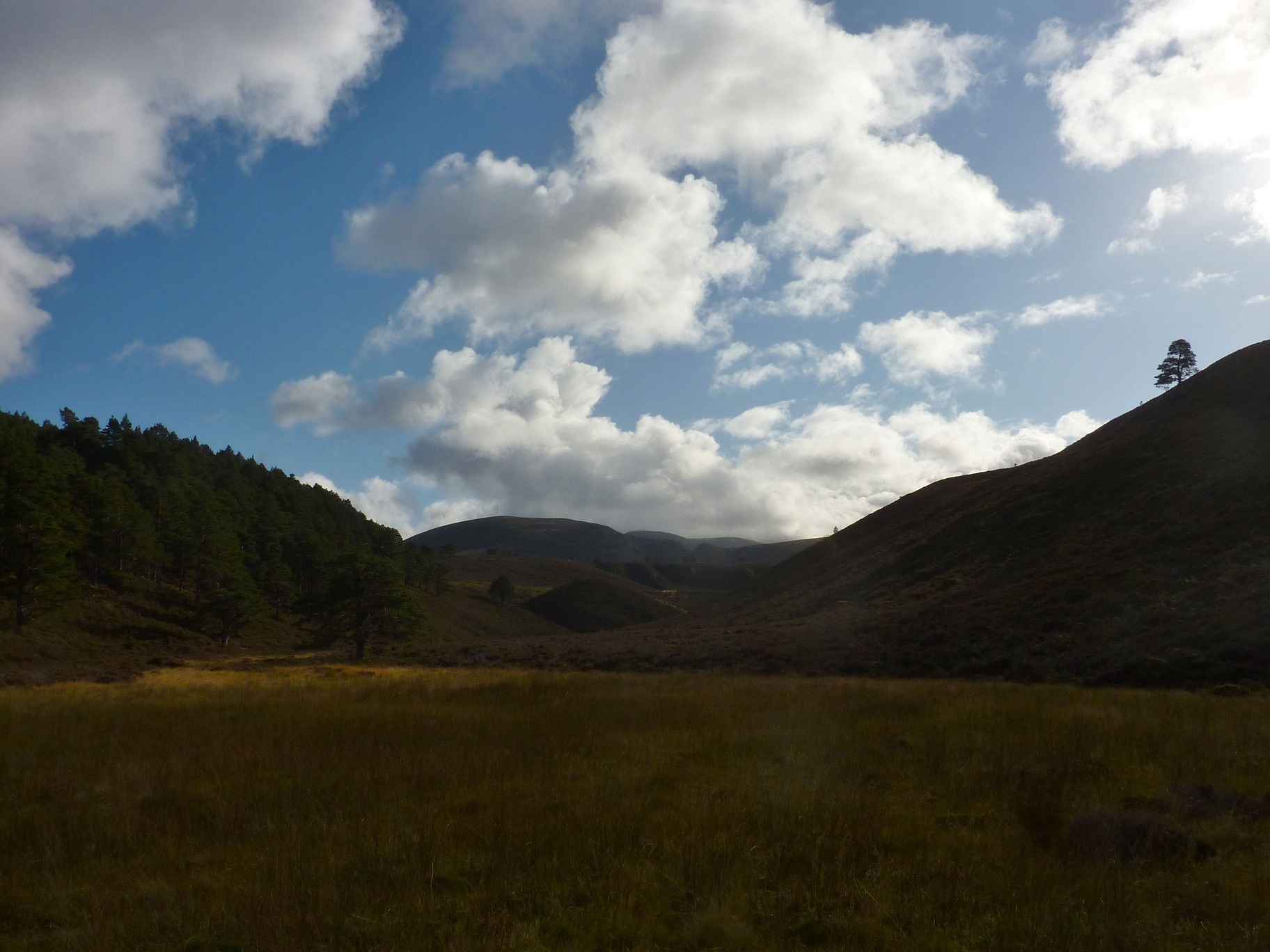
-
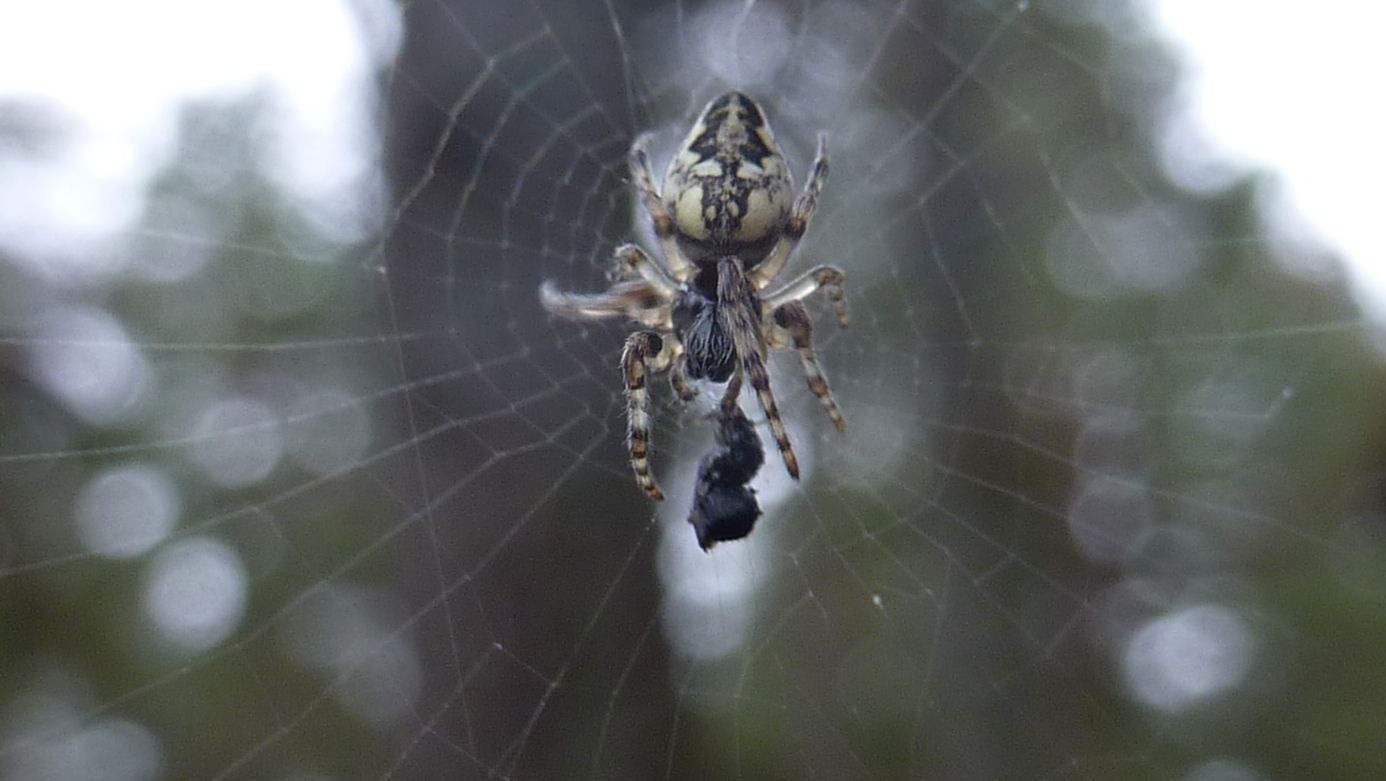
- Cyclosa conica. Gorgeous.
-
- A bat. I know I should do better. I’ve looked through bat pictures and think it might be a pipistrelle?

-
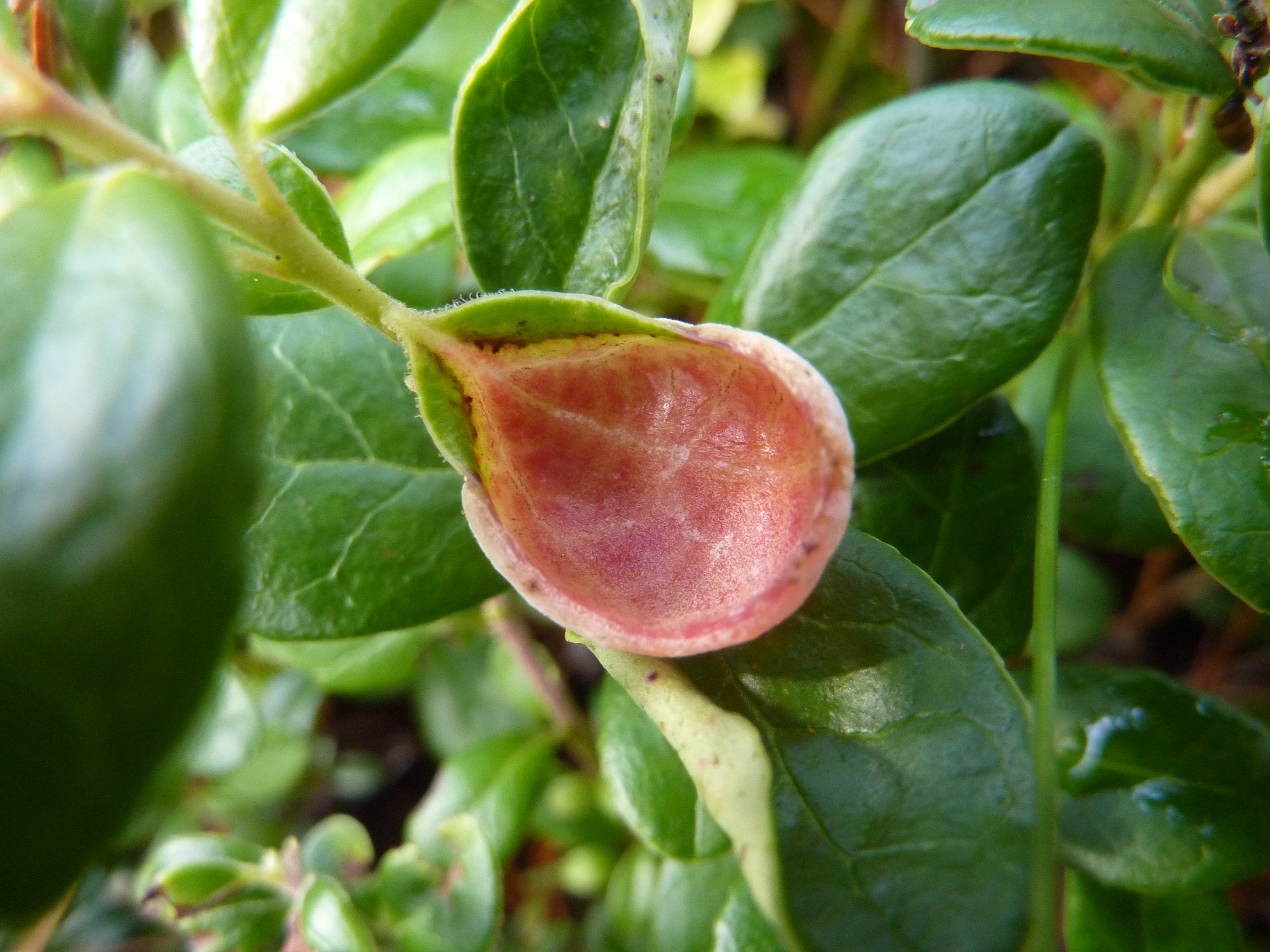
- This gall is caused by the cowberry redleaf fungus (Exobasidium vaccinii)
-
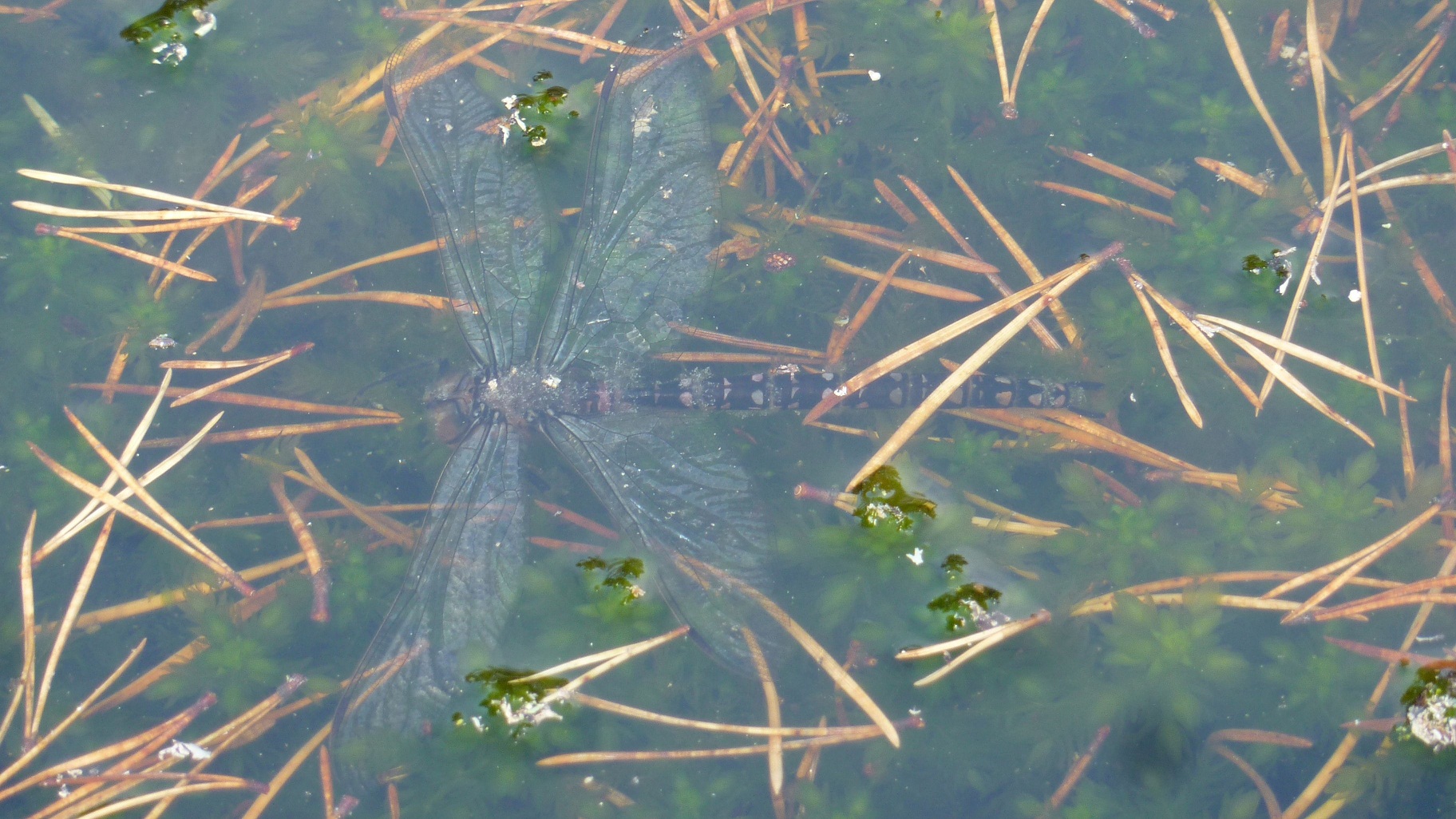
- I think this would have been a common hawker. Now it’s loch detritus.
-
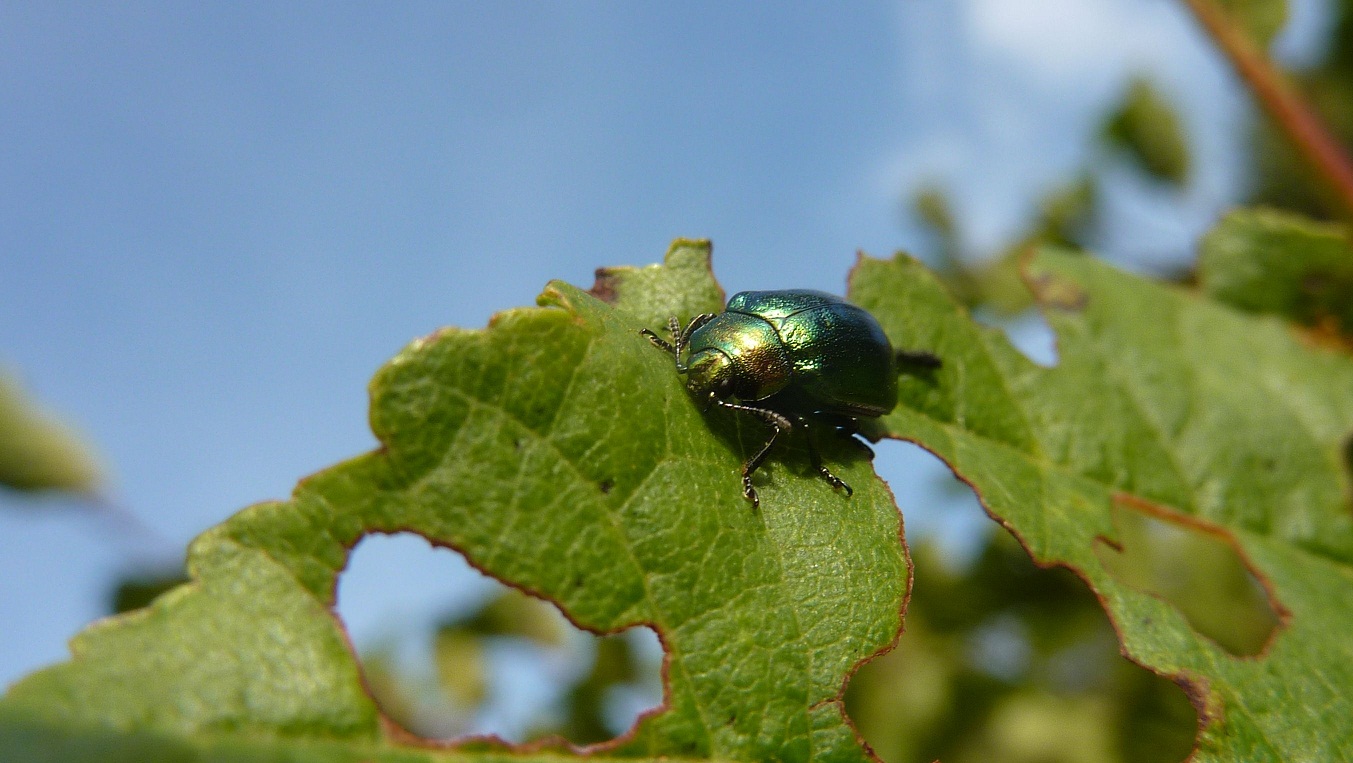
- Green. Iridescent. Amazing. Chrysomela aenea.
-

- These black grouse are practising for the big spring time lekk


 Life since the office
Major endorsements